Europe’s Defeat Is Much LARGER Than It Seems.
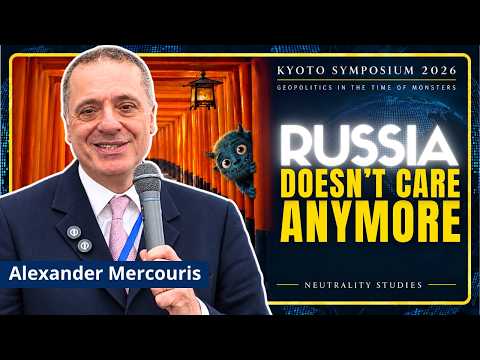
Alexander Mercouris — Kyoto Symposium 2026, Presentation 8
Introduction, editing, and concluding analysis by Jay Rogers
Kyoto, October 14 – 16, 2026 · Recording published October 19, 2026
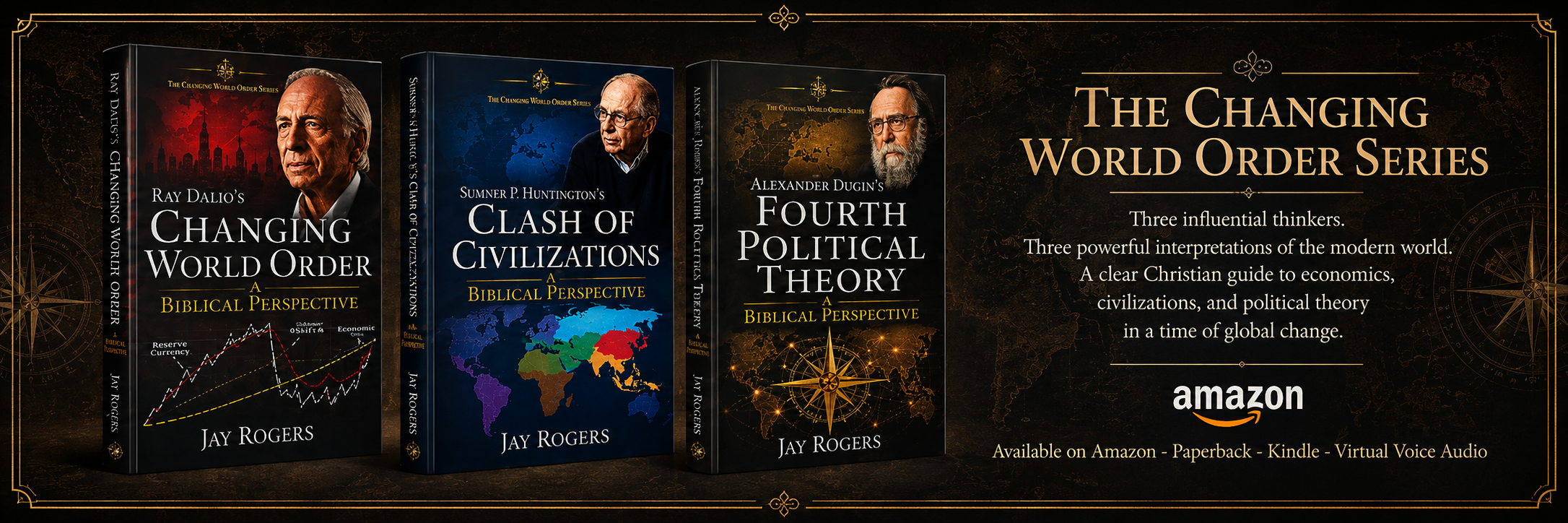
Check out the free book previews including, Paperback, Kindle, and Audiobook formats at: The Changing World Order Book Series
Introduction — The End of the European Age?
By Jay Rogers
I have long argued that we are living through a profound transformation in the world order. The economic, political, and ideological assumptions that dominated the last several centuries are coming under increasing strain. This is the subject of my Changing World Order in Biblical Perspective series, in which I consider three thinkers who anticipated different dimensions of this transformation: Ray Dalio, Samuel P. Huntington, and Aleksandr Dugin.
Dalio investigates the economic and financial cycles that accompany the rise and decline of great powers. Huntington argues that the deepest divisions in a post-Cold War world will increasingly be civilizational rather than merely ideological. Dugin challenges the modern Western political paradigm itself and anticipates a multipolar order in which civilizations rediscover their historical identities. I do not agree with everything any of these men has written. Yet each has identified something important about our present moment.
That is why I found Alexander Mercouris’ recent address at the Kyoto Symposium 2026 so significant. The gathering, held October 14 – 16 at Kyoto University under the theme Geopolitics in the Time of Monsters, brought together scholars and commentators to consider how the international system is changing. Mercouris’ address, released by Neutrality Studies on October 19 as Europe’s Defeat Is Much LARGER Than It Seems, explains the growing crisis of the European great-power system, the economic emergence of China, and what may be a historic reorientation of Russia away from Europe.
The part that interests me most is Mercouris’ argument that the consequences of European and American policy toward Russia extend far beyond the immediate military struggle in Ukraine. In his view, a country that sought recognition as a European power for more than two centuries is increasingly deciding that it does not want to belong to the European system at all. The effects of that change may outlast the present war and the politicians now directing it. He believes that what Europe is losing is not simply influence in one conflict but a central place in a world it helped create.
I have spent years working in Russia and Ukraine, meeting people in both countries and observing their complicated historical relationship with the West. I have also been concerned for many years about the consequences of American foreign policy, especially the attempt to manage an increasingly multipolar world as though Washington could indefinitely dictate the strategic choices of every other great power. There is much to investigate here: NATO enlargement, the treatment of Russian security concerns, the political realignment of Ukraine after 2014, the failure of the Minsk process, and the tendency to substitute military pressure for durable diplomacy. Those questions are not answered merely by rehearsing the slogans of one side or the other.
One of the insights in Mercouris’ address is that the decisions of great powers are influenced not only by objective resources but by perceptions of respect, exclusion, fear, and humiliation. That is particularly important when considering Russia. Policies designed to isolate or weaken Russia may also have accelerated its strategic partnership with China and strengthened its conviction that it must develop outside the West. If so, Western governments may have contributed to the very geopolitical alignment that many of their strategists most wished to prevent.
There is an even broader issue. For centuries European quarrels became world quarrels because European states possessed the power to involve other continents. Now many of the countries once expected to follow the West are declining to participate in its confrontations. Their independent responses reveal a changing distribution of power and a changing sense of civilizational self-confidence. That development is directly relevant to the theses of Dalio, Huntington, and Dugin.
As a Christian, and especially from a postmillennial perspective, I do not equate the history of the Kingdom of God with the fortunes of any one empire, whether American, European, Russian, or Chinese. My interest is in understanding the historical transition and asking what Christians ought to learn from it. The decline of Western geopolitical dominance is not the decline of Christianity. Civilizations can recover their spiritual and moral foundations, even as the political systems built upon those foundations rise and fall.
I have therefore edited Mercouris’ address into readable chapters. I have removed greetings, interruptions, asides, qualifications, and much of the back-and-forth in the question period, while retaining its substantive arguments. My analysis at the end considers how the address illuminates the three central perspectives in my Changing World Order series — and where those perspectives still need further examination.
PART I — THE ADDRESS
Chapter 1. War as the Collapse of Order
War is a collapse of international order and a catastrophe in every respect, most immediately a humanitarian catastrophe. Times of war bring forth real monsters. The jurists at Nuremberg recognized the distinctive gravity of aggressive war because it creates the conditions in which other international crimes become possible.
The primary duty of statesmanship must therefore be to secure and preserve peace. In a world containing several great powers, that requires the careful management of relations among them. Such management cannot succeed without mutual respect. When one great power seeks to maximize its own power at the expense of the others, it creates danger for the entire system.
Smaller states have an essential role, as do neutral states. Their independence and freedom to maintain relations across political divisions can help stabilize the international order. Conversely, efforts by one bloc to align every smaller country against a rival can magnify insecurity and make crises more difficult to contain.
Smaller states are not always passive participants. They may lose sight of the limits of their own power when they believe that an outside patron will support them unconditionally. A government convinced that it can draw on the resources of a great power may be tempted to pursue maximal territorial or strategic objectives. Historical examples proposed here include Serbia before the First World War, Greece in its relationship with Britain, and Israel in its relationship with the United States. Ukraine may also be understood through this pattern, although the circumstances of each case differ substantially.
The general danger is the same: the smaller state may become overconfident, while the larger state becomes entangled in commitments it cannot easily control. Restraint by both is a condition of peace.
Chapter 2. How European Rivalries Became World Wars
For several centuries the international order was centered on Europe. In the nineteenth century, the term great power ordinarily referred to a European power. This reflected the enormous expansion of European economic, technological, maritime, and political influence from the fifteenth century onward.
The European powers also operated within a system of intense rivalry. When relations broke down, competition escalated into war. These conflicts were not caused by diplomacy alone. Underneath the rivalries lay domestic social, political, religious, and economic crises. The Thirty Years’ War cannot be separated from the conflict between Protestantism and Catholicism; the Napoleonic wars cannot be understood apart from the French Revolution; and the world wars of the twentieth century took place amid profound internal tensions, including the rise of organized labor and socialist politics.
Diplomatic history sometimes isolates interstate relations from these deeper currents. Yet great-power competition and domestic crisis continually affected one another. A crisis within a society could intensify foreign rivalry; a foreign conflict could further destabilize the society that entered it.
European empires spread this system far beyond Europe itself. Britain, France, Spain, Portugal, the Netherlands, and other imperial powers held colonies and commercial networks across the Americas, Africa, and Asia. Russia’s great-power development took a different geographical form, rooted in an expanding contiguous empire rather than comparable overseas colonial networks.
Because the European powers had become global empires, their quarrels became global wars. The First World War began as a European crisis and drew in peoples from across the world. The Second World War had additional centers of conflict, including Japan’s expansion in Asia, but the European war was still a decisive part of its worldwide escalation. For much of modern history, the struggle for global order remained inseparable from the struggle for power within Europe.
Chapter 3. Russia’s Long European Orientation
Russia joined the European great-power system in the eighteenth century. From the reign of Peter the Great onward, its governing elite increasingly saw the country as a European power participating in the same diplomatic, cultural, and ideological arguments as its western neighbors.
The Russian Revolution of 1917 is often treated as a fundamental departure from Europe. Yet socialism and Marxism were themselves products of Europe’s intellectual and social crisis. Many Russians who embraced revolutionary ideas believed they were participating in a European struggle over class, labor, industry, and the future of society. In that sense, the Soviet Union did not understand itself simply as having left European history.
The Second World War strengthened an important element of that self-conception. Soviet leaders presented the war as a defense of the motherland and as a campaign to liberate Europe from fascism. In November 1941, as German forces threatened Moscow, Stalin invoked the wider struggle against the German invasion. Whether one accepts the Soviet account of liberation is a separate matter; what matters here is that Soviet leaders and many Soviet citizens understood their role through the language of a European mission.
Popular culture also reflected that outlook. The influential 1970s Soviet television drama Seventeen Moments of Spring, about a Soviet intelligence officer operating in Nazi Germany, included a Catholic priest as an ally in the anti-fascist struggle. The story located Soviet resistance within a broader European moral and political struggle. The political and religious traditions differed, but Soviet audiences could still imagine themselves fighting for the future of Europe.
There was always a competing Russian tradition. Writers such as Fyodor Dostoevsky, along with other conservative and Slavophile thinkers, questioned whether Russia should seek complete assimilation into Western Europe. They argued that Russia possessed its own distinctive cultural and spiritual inheritance. For much of the eighteenth, nineteenth, and twentieth centuries, however, the aspiration to be recognized as a European great power remained exceptionally influential.
That assumption survived the Soviet collapse. In the 1990s Russia turned again toward Europe, expecting some form of integration into a broader continental order. The significance of the present crisis is that this long-standing orientation is now being challenged at a fundamental level.
Chapter 4. The End of Europe’s Exclusive Claim to Greatness
The European-centered system still appeared durable in the early 1960s. Decolonization was underway, but the established Western powers remained dominant in the prevailing European and American understanding of world affairs. The Cold War, despite its worldwide consequences, was generally conceived in Washington, Moscow, and Western Europe as a confrontation whose principal strategic theater was Europe.
That conception has become increasingly difficult to sustain. Europe’s and the United States’ relative advantages in manufacturing and technology are no longer as overwhelming as they once appeared. Above all, China has become a major economic, industrial, and technological power that cannot be fitted into the traditional European great-power system.
China is not a former European empire adapting to a new balance of power. It is a civilization with its own history, institutions, and account of its place in the world. Its influence therefore changes not only the distribution of resources but the very assumptions on which Western conceptions of world order were built.
Other Asian powers are also becoming more assertive. India, once understood in Western discussions principally through the legacy of British colonial rule and the challenges of poverty and development, increasingly pursues an independent foreign policy and great-power ambitions. Iran and other states similarly resist being treated as subordinate participants in an order established elsewhere.
The cultural implications are as important as the strategic ones. In 1969 the BBC presented Kenneth Clark’s influential television series Civilisation. The title was used primarily to describe the development of Western European art and culture. That choice reflected a world in which European civilization could still be treated, within prominent Western institutions, as the central story of civilization itself.
Today the assumption looks increasingly provincial. China, India, and the Islamic world cannot plausibly be treated as peripheral to a history of civilization. What appears to Western observers as China’s sudden arrival is not sudden from the standpoint of Chinese history. It is sudden because Western institutions are encountering a powerful civilization that no longer accepts a subordinate position.
Chapter 5. The Financial Crisis of 2008 and the Reaction of the West
The financial crisis of 2008 was a turning point in how Western elites perceived the international system. The near collapse of the Western financial system created alarm in banking and government circles. At the same time, China’s large domestic economic stimulus helped sustain demand in a troubled global economy. A country that had been treated as an emerging participant was now visibly essential to global stability.
The psychological effect was profound. The Western powers were forced to confront not only their own financial fragility but the possibility that economic initiative was shifting elsewhere. China was no longer merely a source of inexpensive manufactured goods or a potential future competitor. It had become indispensable to the functioning of the existing system.
In the years that followed, the United States and its allies became increasingly concerned with consolidating the Western alliance structure and preserving their global position. One strategic question was whether Russia could be drawn closer to the West, thereby preventing its deeper alignment with China. Another was how to limit Russia’s freedom of action when it resisted that alignment.
Ukraine became a central arena of confrontation. The circumstances were complex, and the conflict cannot be reduced to a single cause. But from the Russian perspective, Western policy increasingly appeared to be an effort to turn Ukraine into part of a hostile coalition on Russia’s border. These perceptions played a major part in the Russian leadership’s approach to the crisis.
The general pattern is familiar from earlier great-power systems. A dominant power, troubled by the erosion of its position, intensifies its efforts to maximize strategic advantage. Rivals interpret those efforts as threats and respond by hardening their own positions. Policies designed to strengthen security can thereby create greater insecurity for all.
Chapter 6. Ukraine and Russia’s Sense of Rejection
The war in Ukraine is perceived differently by the parties involved. In Russia, the leadership and many of its supporters do not understand it simply as a bilateral dispute with Ukraine. They see it as a conflict with a Western coalition that has armed Ukraine and supported military operations against Russian forces. Strikes within Russian territory have reinforced that interpretation.
This perception is linked to a broader historical grievance. Russians who grew up with the story of their country as a European power, and of the Soviet Union as a force that helped defeat Nazi Germany, have come to believe that Europe has rejected Russia altogether. The result is an increasingly powerful sense of betrayal and anger.
That anger is evident beyond the usual nationalist and security-policy circles. At gatherings in Russia attended in 2025 and 2026, commercial lawyers and other educated professionals who had previously maintained extensive Western contacts expressed deep disillusionment. Some people who might once have been described as liberal or pro-European no longer expected a constructive relationship with the West. Others expressed troubling views about the need for a more authoritarian political order within Russia itself.
This matters because the breakdown is not simply a dispute between governments. A change is taking place in the assumptions of people who formerly favored Russian participation in a common European political and cultural space.
Chapter 7. Russia as a Civilization-State
The most consequential change may be Russia’s new description of itself as a civilization-state rather than merely a European nation-state. This is no longer simply a fringe notion held by a few Russian conservative thinkers. It has entered the official vocabulary of the Russian government.
The distinction is substantial. A European nation-state, participating in the familiar balance-of-power system, seeks recognition and influence within that system. A civilization-state claims a deeper and broader historical identity, one that cannot be fully defined by the institutions and political assumptions of modern Europe.
Russia’s government now speaks of relations with China and India in explicitly civilizational terms. These countries are presented as civilizations with distinctive histories and perspectives, entitled to shape an international order that is not directed exclusively by the West.
In this sense Russia is turning away from the European system in which it had sought a central role since the eighteenth century. It is developing its partnerships with China and India, extending its strategic attention toward Southeast Asia, and imagining its future increasingly in Eurasian and wider global terms.
This is not merely a change of diplomatic orientation. It is a proposed change of historical identity. A former European great power is defining itself as something larger and different. The rejection may prove lasting even if present political disputes eventually become more manageable.
The process is also self-reinforcing. Russia’s turn away from Europe alarms Western decision-makers who may have hoped that Russia could ultimately be aligned against China. Western hostility then strengthens the argument inside Russia that no lasting accommodation with Europe is possible. The more both sides organize their strategy around that assumption, the harder it becomes to reverse.
Chapter 8. America, the Non-Western World, and Europe’s Diminishing Centrality
There is no single American position on these questions. Some Americans favor maintaining a far-reaching alliance system and confronting multiple adversaries. Others, including individuals associated with the Christian right and former military personnel, regard America’s assumption of the role of a European great power as a historical mistake.
From that second perspective, the United States was founded with a political tradition that should have restrained its involvement in the old European balance-of-power struggles. Its later transformation into a dominant actor in European affairs involved obligations and ambitions very different from those associated with the country’s founding ideals.
The argument resonates with domestic pressures. Living standards, industrial competition, public debt, and political distrust contribute to a sense of national exhaustion. Members of the armed forces also recognize the danger of political leaders assigning them strategic objectives that exceed the resources available.
Meanwhile, states outside the West have often refused to take sides in the manner European governments expected during the Ukraine war. Many countries wished to preserve relations with both Russia and Western powers rather than join a comprehensive program of diplomatic and economic isolation. Their behavior illustrates the growing autonomy of states once expected to follow European leadership.
In past centuries European countries could internationalize their conflicts because their empires and alliances reached across the world. Today they cannot assume that countries in Asia, Africa, the Middle East, and Latin America will subordinate their interests to Europe’s rivalries.
This may be the most striking reversal of all. Europe remains wealthy, institutionally important, and militarily significant. Yet it may cease to be the principal theater in which the future of the international system is decided. Its former centrality is increasingly challenged by an order in which critical choices are also made in Beijing, Washington, New Delhi, Moscow, and elsewhere.
PART II — FURTHER ARGUMENTS FROM THE DISCUSSION
Editor’s note. The following chapters draw on Mercouris’ answers to questions after the address. Audience members raised issues that sometimes challenged his assumptions. Their contributions are summarized only insofar as necessary to make his answers understandable; ideas advanced solely by questioners are not attributed to Mercouris.
Chapter 9. Military Planning and the Problem of Peace
An audience member pointed to changes in Western military doctrine, including concepts of hybrid warfare and multi-domain operations, and described research suggesting that European military resources were increasingly being understood through the lens of confrontation with Russia.
The deeper problem, in Mercouris’ reply, is a style of policy that treats rivalry and conflict as the normal instruments of international management. Strategic planners may focus on weakening an adversary or exploiting a proxy conflict when the proper task of statesmanship should be to preserve peace.
The Minsk agreements provided a diplomatic framework for a political settlement concerning eastern Ukraine. The United Nations Security Council endorsed the 2015 Package of Measures unanimously in Resolution 2202. It provided a possible route toward de-escalation and a negotiated arrangement, though the parties disagreed over sequencing, implementation, and political authority. Mercouris argues that a serious effort to make this framework work would have been preferable to the subsequent escalation of military competition. The failure to implement a durable settlement deserves a central place in any account of how the conflict developed.
Chapter 10. Did Russia Leave Europe — or Was It Pushed Out?
A questioner challenged the image of Russia voluntarily leaving Europe. Had Europe, in effect, expelled Russia from a community to which it long considered itself to belong?
The distinction matters. European attitudes toward Russia have often contained a strong exclusionary current. Russia was regarded by some as too large, too different, religiously distinct, or politically incompatible with the countries to its west. Such views became more pronounced during periods of conflict.
For much of its modern history, however, Russia chose to look past these attitudes. Even during the Second World War, when Nazi Germany framed its invasion in civilizational terms, the Soviet Union claimed a place within Europe’s future. It presented itself as the defender of a progressive Europe against fascism.
That willingness to insist on Russia’s European membership is now weakening. Even among Russians who were once favorably disposed toward Western institutions, the belief is growing that Europeans will never accept Russia as a legitimate partner. In that sense the turn away is both a response to exclusion and an increasingly deliberate choice.
Putin himself emerged from a political environment in which Russia’s European identity was taken seriously. His public diplomacy and personal relationships once emphasized leaders such as Jacques Chirac, Gerhard Schroeder, and Silvio Berlusconi. Mercouris regards Putin as relatively cautious in his approach to relations with Europe when compared with some more radical voices in Russian politics. He nevertheless sees the president’s rhetoric becoming harsher. At the conferences Mercouris attended in Russia in 2025 and 2026, even people with longstanding professional relationships in the West described a dramatic collapse of confidence. He also heard voices advocating a more authoritarian internal direction. He regarded those currents as worrying, though not necessarily representative of the whole of Russian society.
Mercouris considers a simple return to the prewar language of a common European home unlikely. Russia may want stable and peaceful western borders while no longer seeking reintegration into a Europe-centered order. The separation may be deeper than the tenure of any particular government.
Chapter 11. China, American Strategy, and the Inertia of the Cold War
Another questioner objected to describing China’s rise as sudden. From a Chinese perspective, a civilization with a long and continuous history is not newly appearing in world affairs. The surprise belongs primarily to the European observers who presumed that the great powers would continue to be European or culturally Western.
China’s diplomacy toward the Ukraine conflict reveals this shift in expectations. Beijing offered proposals and sent an envoy to discuss the possibilities of a settlement. Some European commentary reacted as though an Asian power was intruding into a European diplomatic domain. The episode revealed how difficult it had become to maintain the old boundaries of great-power legitimacy.
In Washington, there is a broad strategic recognition that China poses a larger long-term economic, industrial, technological, and maritime challenge than Russia. Yet some American policymakers also appear to believe that Russia ought naturally to be closer to the West than to China. If Russia seems weaker and more susceptible to pressure, it can become the immediate focus of efforts to alter that alignment.
Institutional inertia also matters. Military, intelligence, and legislative structures formed during the Cold War were organized around the Soviet Union as the central adversary. After the Soviet Union dissolved, hostility could be transferred to the Russian Federation without requiring a complete reexamination of assumptions. Commitments to the Baltic states and Ukraine acquired their own political and bureaucratic momentum.
A strategy that confronts Russia and China at the same time risks exceeding American capacities. It may even produce the opposite of its intended effect by pushing the two countries into a closer strategic partnership.
Chapter 12. Sanctions, Resilience, and the Limits of Coercion
Western financial sanctions were expected by many observers to impose enormous costs on Russia. Before 2022, Russian leaders themselves were anxious about the possibility of exclusion from major Western financial networks, given the size of Western economies compared with Russia’s.
Yet Russian institutions had undertaken preparations, including the creation of a domestic financial-messaging system as an alternative to reliance on SWIFT. The initial sanctions did not cause the instantaneous economic collapse that some expected. Russia was able to reroute significant trade, adapt institutions, and sustain a wartime economy.
This experience changed Russian expectations about Western power. The failure of sanctions to produce an immediate collapse weakened the earlier assumption that economic dependence on the West necessarily gave Western governments decisive leverage over Russia.
A country that discovers it can endure a punishment it once feared may become less susceptible to future threats of the same kind.
The consequences extend beyond finance. As Russia judges Western military inventories and the resilience of other states confronting Western pressure, its assessment of the balance of power changes. Diplomacy becomes more difficult when one side assumes coercion will be decisive and the other concludes that coercion has lost much of its force.
Chapter 13. Civilization-State or European Nation-State? The Unfinished Russian Debate
In the final exchange, a participant questioned whether Russia had ever been truly European in the same sense as the states of Western Europe. Russia’s long attraction to the political and cultural prestige of Paris, Berlin, and the modern West might be compared, the participant suggested, to the Ottoman and Persian empires’ efforts to modernize under European influence. From this standpoint, Russia’s present turn was not so much a departure from its nature as a recovery of an older and non-Western identity.
The question raised a second problem. A government may describe itself as a civilization-state while continuing to operate within the legal and bureaucratic assumptions of the modern sovereign nation-state. The principles of territorial sovereignty, interstate diplomacy, and the Westphalian system remain embedded in Russian institutions. Adopting the language of civilization does not necessarily mean that a civilization has developed a distinct political form.
Mercouris answered by placing that tension within Russia’s own history. Conservative Russian thinkers, including Dostoevsky and the Slavophiles, had long insisted that their country could learn from European achievements without being absorbed into European civilization. They believed that efforts to dissolve Russia’s distinctive character within the West had produced profound cultural and political difficulties.
For much of modern Russian history, however, this had not been the dominant view. The achievements of Peter the Great and Catherine the Great had made Europeanization seem vindicated by success. Russia became a great power, established St. Petersburg as a European capital, and participated at the highest level in European diplomacy and elite culture. The imperial and later revolutionary elite understood itself to be participating in Europe’s historical struggles, not merely borrowing an alien ideology from outside.
The socialist movement that transformed Russia in the twentieth century was likewise closely connected with European intellectual and political history. Russia’s revolutionaries believed they were advancing a struggle taking place throughout Europe. For Mercouris, the magnitude of the present change lies in that deeply rooted identification’s apparent disintegration. Russia may retain the institutions of the modern state while increasingly refusing Europe’s claim to be the measure of civilization.
The final question remains unresolved: will the rhetoric of a civilization-state produce new institutions and a durable political identity, or will it remain a new label for old great-power practices? The answer will matter not only for Russia but for the wider international system.
PART III — CRITICAL ANALYSIS BY JAY ROGERS
Three Theories and One Civilizational Transition
1. Dalio: The Economic Foundations of a Changing World Order
In my study of Ray Dalio, I have argued that a great-power system cannot be understood apart from the economic forces that sustain it. Productive capacity, technology, education, financial markets, debt, monetary credibility, and reserve-currency status all influence the rise and decline of empires. Great powers do not maintain their position by military force alone. They must be able to produce, finance, and replenish the resources on which power depends.
Mercouris’ treatment of 2008 is therefore more than a passing historical reference. The global financial crisis exposed the vulnerabilities of a Western-led system while highlighting China’s growing industrial and financial importance. It also intensified questions about whether the advantages that sustained Western primacy could be maintained indefinitely. The point is not that one financial crisis proves an entire theory of imperial decline. It is that economic shocks can accelerate political changes that have been building for decades.
I see the present period as part of a much longer transition in which the extraordinary Western dominance of the last several centuries is becoming less exclusive. Dalio’s account of the Big Cycle is a useful framework for studying that transition, especially the relationships among public and private debt, monetary policy, internal social division, and external competition. My own analysis has treated the years from 2008 to 2028 as an especially important period of transition, not as a predetermined date for the fall of an empire. It also asks whether the moral and economic principles reflected in the biblical Jubilee can illuminate the dangers of accumulated debt and entrenched inequality.
Mercouris adds a significant geopolitical dimension: financial weakness and the fear of declining status can encourage aggressive strategic behavior. Yet this remains an interpretation to be tested rather than an automatic causal law. The United States retains enormous strengths, including universities, capital markets, military alliances, and technological capabilities; Western decline is relative, uneven, and contestable rather than an accomplished collapse.
A change in the world order begins with material realities. The inability to command production, finance, and technology on the old terms places limits on the political ambitions of even the most powerful states. To speak of peace while ignoring those limits is to mistake reputation for capability.
2. Huntington: A European Great Power Becomes a Civilization-State
Mercouris’ central thesis about Russia comes especially close to Samuel Huntington’s Clash of Civilizations. Huntington distinguished civilizations by their histories, cultures, languages, institutions, and above all their religious inheritances. He regarded Russia as the core state of an Orthodox civilization, not simply as another European nation-state waiting to adopt the norms of the modern West.
In my Huntington volume, I emphasize the difference between modernization and Westernization. A country can acquire modern industry, advanced weapons, and sophisticated technology without surrendering its distinctive civilizational identity. The rise of China demonstrates this dramatically; Mercouris argues that Russia’s changing identity supplies another example.
His description of Russia’s departure from the European system is therefore interesting for two reasons. First, it suggests that the world cannot be analyzed solely in terms of the ideological blocs of the twentieth century. Second, it shows the language of civilization moving from academic theory into the operating vocabulary of major states. Russia’s March 2023 foreign-policy concept explicitly calls the country a distinctive country-civilization, a Eurasian and Euro-Pacific power. This is documentary evidence of a change in official language, even if the depth of that change throughout Russian society remains a question for historians.
Ukraine is one of the clearest illustrations of Huntington’s argument. Huntington described Ukraine as a country crossed by major cultural and civilizational lines. In my own analysis, I have argued that Ukraine might have served as a bridge between Russia and the West rather than becoming an increasingly militarized frontier. Its historical, linguistic, ecclesiastical, and political connections run in different directions. Those complexities made a stable, mutually acceptable settlement especially important. The policy choices of outside powers — including those made in Washington and European capitals — should be assessed in light of the predictable consequences of turning this divided borderland into an arena of great-power competition.
The actions of countries outside Europe reinforce another of Huntington’s observations. A multipolar and multicivilizational world will not necessarily organize itself around the priorities of a single Western alliance. Governments in Asia, Africa, Latin America, and the Middle East have their own calculations, traditions, and strategic relationships. Their unwillingness to participate in comprehensive sanctions or diplomatic isolation may reflect differing views of the conflict, resistance to Western pressure, economic interest, or a principled preference for nonalignment. The central point is that the West can no longer expect automatic worldwide compliance.
Huntington also saw the importance of nuclear-armed core states in deterring direct civilizational war. A measure of stability at the highest level, however, can coexist with dangerous proxy conflicts, sanctions, cyber operations, and other forms of indirect pressure. That is one reason Mercouris’ opening appeal to restraint cannot be dismissed as sentimental idealism.
Mercouris provides a compelling illustration of why the nation-state alone is no longer a sufficient unit of geopolitical analysis. The civilization-state is becoming more explicit. Civilizational analysis must also explain differences within civilizations as well as between them. Religious, linguistic, and historical affinities do not always dictate identical strategic priorities.
3. Dugin: The Crisis of Modernity and the Search for a New Political Form
Aleksandr Dugin carries this argument into philosophy. Where Dalio analyzes the economic cycle and Huntington maps the civilizational order, Dugin challenges the underlying presuppositions of modern Western political thought. His Fourth Political Theory is an attempt to move beyond the modern ideologies of liberalism, communism, and fascism and to imagine a multipolar world in which civilizations recover their own histories, traditions, and organizing principles.
Mercouris does not set out to defend Dugin’s philosophy. Indeed, one of the revealing features of his speech is that he approaches the same development from the opposite direction. Mercouris begins with Russia’s long aspiration to belong to Europe and argues that geopolitical rejection has helped drive a change in Russian self-understanding. Dugin begins with the conviction that Russia was never merely a branch of Western Europe and ought not to measure its identity by Western standards. The two perspectives converge in their description of a post-Western order, but they differ on whether Russia is recovering an older essence or abandoning a long historical orientation.
That distinction matters. If Mercouris is right, Russian civilization-state rhetoric is partly a response to exclusion, war, sanctions, and diplomacy. If Dugin is right, those events have exposed a deeper mistake in Russia’s centuries-long effort to become Western. Both explanations may contain an element of truth; neither should be accepted without scrutiny.
In my Dugin volume, I argue that Christians should engage his critique of liberal modernity without simply adopting his philosophical system. Human beings are not isolated economic units. They belong to families, communities, languages, traditions, and covenants. But the answer to the failure of modern ideologies is not to declare every inherited tradition equally true or every civilizational leader legitimate merely because he claims to defend tradition.
Civilization requires an organizing logos, but Christianity gives that word a meaning far beyond Dugin’s pluralism. The Logos is not merely the spiritual self-description of the Russian, Chinese, American, or Indian civilization. The Logos is Jesus Christ, through whom all things were made and before whom every political order is accountable. That is why my Christian response to Dugin cannot be an endorsement of an unlimited civilizational sovereignty.
Nor do I believe the American solution is to imitate Russia or China. America grew out of a long Christian inheritance, including covenantal ideas of law, liberty, responsibility, family, and limited government. Our task is to recover what is genuinely Christian in that inheritance while correcting its failures, not to substitute a foreign civilizational model for our own.
Mercouris offers a historical account of the crisis to which Dugin offers a philosophical response. Together they demonstrate why the emerging order is not simply a reshuffling of alliances. It is a dispute over the meaning of civilization itself.
4. American Policy, European Miscalculation, and the Limits of the Argument
The strength of Mercouris’ presentation is its integration of power and perception. An international order is not held together by economic statistics alone. It also depends on whether its major participants believe their security interests and their status are being respected. Policies that persuade a rival it faces permanent exclusion may help produce the very hostile alignment they were designed to prevent.
I find this especially relevant when considering American policy since the Cold War. In 2008 NATO formally declared that Ukraine and Georgia would eventually become members. The declaration did not provide a timetable or immediate membership, but it plainly established a strategic direction that Moscow had repeatedly opposed. After the upheaval of 2014, the conflict in eastern Ukraine and the failure to implement the Minsk agreements became inseparable from the growing confrontation between Russia and the West. Security policy came to be dominated by alliance expansion, sanctions, military assistance, mutual distrust, and competing accounts of legitimacy. I believe these decisions and their cumulative consequences require considerably more examination than they ordinarily receive in American political debate.
In particular, it is worth asking why Western governments repeatedly assumed they could impose costs on Russia without permanently changing Russia’s orientation toward Europe. Mercouris suggests that the greatest consequence of those policies may be the alienation of an entire generation of Russians, including people who had once been sympathetic to Western Europe. If that is correct, it represents a strategic loss whose effects may last decades. The West wanted to prevent a powerful Eurasian counterweight. Its policies may instead have helped consolidate one.
The failure of diplomacy is inseparable from that larger mistake. Mercouris emphasizes the possible stabilizing influence of neutral states and of smaller states that refuse to become instruments of another power’s confrontation. This need not be romanticized. Neutrality involves difficult practical decisions and cannot settle every territorial or constitutional disagreement. Nevertheless, a European security system that leaves no credible room for neutrality, compromise, or mutually accepted limits invites recurrent crises.
Mercouris’ analysis remains an argument rather than a complete explanation. Domestic politics in Ukraine and Russia, changes in Ukrainian public opinion, the role of European governments that disagree among themselves, and policy choices made in Moscow all require separate attention. American influence is enormous, but not every local decision can be reduced to Washington. These are additional variables to investigate rather than reasons to neglect his central contention about a deep failure of Western strategic judgment.
His economic language also deserves precision. China has an overwhelming industrial base, but the comparison depends on how output is measured. UNIDO’s 2024 yearbook estimated that China produced 31.8 percent of global manufacturing value added in 2023, compared with 15.0 percent for the United States. That is slightly more than twice the American share rather than the threefold ratio mentioned in the address. It nevertheless reinforces the central point: the old Western predominance in manufacturing cannot be taken for granted.
Likewise, Russia’s ability to withstand the initial shock of sanctions does not mean those sanctions have imposed no costs. Its economy has adapted in important ways, while also facing technological, financial, labor, and budgetary pressures. The more significant geopolitical observation is that sanctions which failed to produce the anticipated immediate collapse may have altered Russian perceptions of their vulnerability, reduced confidence in Western financial institutions, and encouraged alternative arrangements.
Finally, Europe is neither literally finished nor economically irrelevant. It remains wealthy, technologically sophisticated, and deeply integrated into global trade. What Mercouris convincingly describes is a loss of relative centrality: Europe can no longer assume that its quarrels will define the world’s agenda, or that Russia will indefinitely seek admission to a Europe-centered political order. That is a more defensible and, in the long run, more consequential claim than a headline announcing the death of Europe.
5. A Christian Perspective: Peace Without Illusions, Hope Without Empire
I find Mercouris most valuable where he insists that the first responsibility of statesmanship is to preserve peace. Political leaders who become intoxicated by prestige, national greatness, or the fantasy of unlimited power may bring destruction on the very peoples they claim to defend. The biblical tradition gives us ample reason to distrust such arrogance.
Yet peace cannot be separated from the biblical understanding of righteousness. Scripture demands truthful judgment, measured government, just weights and measures, fidelity to covenants, and restraint in the exercise of political authority. A stable international order requires something deeper than permanent military threats or the ambitions of rival elites. The enduring test is whether rulers exercise power according to principles of justice that do not change with the balance of military forces.
This is where my Changing World Order series moves beyond its three secular or non-Protestant conversation partners. Dalio helps explain how the material power of empires changes. Huntington shows why religion and civilizational identity remain important after the Cold War. Dugin poses the question of the spiritual and philosophical foundations of a postliberal world. None of them supplies, by himself, an adequate biblical account of history or political responsibility.
From a postmillennial Christian perspective, I do not interpret the end of Western dominance as the end of Christian hope. Empires rise and fall, and the kingdom of Christ is not identical with any of them. The Great Commission does not depend on maintaining American unipolarity, Russian power, or European supremacy. Nor does Christian hope require the destruction of rival civilizations. It calls us to evangelize, teach, build institutions, practice justice, and cultivate lawful peace among the nations.
The question, then, is not simply which power will dominate the twenty-first century. It is what kind of civilization we are prepared to build as the old assumptions lose their hold. The world order is changing. That should make Christians neither fearful spectators nor uncritical admirers of whichever state appears to be rising. It should make us more serious about our own obligations under the lordship of Jesus Christ.
– Jay Rogers
EDITORIAL SOURCE NOTE
The central text is a substantial, edited prose adaptation of the complete address and ensuing audience discussion, prepared from the supplied transcript. Disfluencies, greetings, advertisements, repeated qualifications, and conversational interruptions have been removed; paragraphs and chapter titles are editorial. The principal arguments, examples, and distinctions have been retained. Responses to audience questions are set apart from the prepared address. This is an editorial adaptation rather than a certified verbatim transcript; the narrative wording has been standardized for reading, while the speaker’s main ideas, examples, and distinctions are retained. In particular, Mercouris’ descriptions of what Russians, Europeans, or Americans believe are presented as his assessments, not independently established facts. The introduction and final analysis are separate commentary in Jay Rogers’ first-person voice, not part of the original address. The symposium was held at Shiran Kaikan, Kyoto University, and the recording appeared on the Neutrality Studies channel as Europe’s Defeat Is Much LARGER Than It Seems.
EDITORIAL SOURCE NOTES
1. Original address and video: Alexander Mercouris, Presentation 8, Kyoto Symposium 2026: Geopolitics in the Time of Monsters, Shiran Kaikan, Kyoto University, Kyoto, Japan, October 14 – 16, 2026. Published by Neutrality Studies on October 19, 2026, as Europe’s Defeat Is Much LARGER Than It Seems. https://www.youtube.com/live/RhehJpkA5SM . The supplied transcript runs approximately 64 minutes and includes the complete question period. The precise calendar day of Mercouris’ delivery within the three-day conference has not been established in this edition.
2. Nature of this edition: Speech and answers transformed into organized prose; greetings, filler, advertisements, repeated conversational phrases, and some interchanges removed. The chapters are editorial; this is a substantial adaptation rather than a literal transcript. Statements attributed to Mercouris are his arguments and reported perceptions. Audience views are identified as such. The introduction and concluding analysis are separate commentary.
3. The book series: Jay Rogers, Ray Dalio’s Changing World Order in Biblical Perspective; Samuel P. Huntington’s Clash of Civilizations in Biblical Perspective; Aleksandr Dugin’s Fourth Political Theory in Biblical Perspective, and the combined Changing World Order master volume.
4. Russian civilizational language: The Concept of the Foreign Policy of the Russian Federation (March 31, 2023), section 4, characterizes Russia as a distinctive “country-civilization,†a Eurasian and Euro-Pacific power. https://russiaun.ru/en/news/foreignpolicy
5. NATO Bucharest Summit: Bucharest Summit Declaration, April 3, 2008, paragraph 23, stated that Ukraine and Georgia would become NATO members. https://nato.int/en/about-us/official-texts-and-resources/official-texts/2008/04/03/bucharest-summit-declaration
6. Minsk: United Nations Security Council Resolution 2202 (February 17, 2015) unanimously endorsed the Package of Measures for Implementation of the Minsk Agreements. https://press.un.org/en/2015/sc11785.doc.htm
7. Manufacturing comparison: UNIDO, International Yearbook of Industrial Statistics 2024, estimated shares of global manufacturing value added in 2023: China 31.8 percent and United States 15.0 percent. https://www.unido.org/sites/default/files/unido-publications/2024-11/YB-core-2024-yearbook-pdf.pdf
8. Symposium information: Neutrality Studies, conference schedule and venue, https://neutralitystudies.com/events