The Fourth Political Theory & a World in Transition
The Question: What Comes Next?
What if the political chaos we are living through is not simply another election cycle? What if something much bigger is happening?
For more than a century, the modern world has been dominated by three great political ideologies: liberalism, communism, and fascism. Two were defeated catastrophically. And Aleksandr Dugin argues that the third, liberalism, is now entering a crisis of its own.
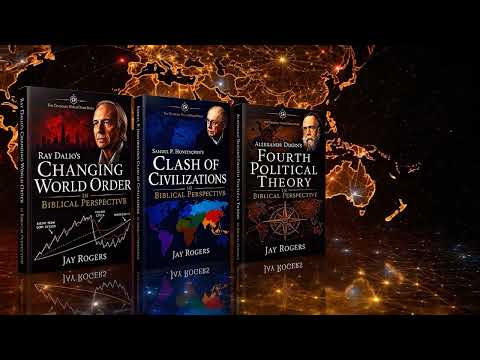
Check out the free book previews including, Paperback, Kindle, and Audiobook formats at: The Changing World Order Book Series
Now, you may strongly disagree with Dugin. I disagree with him on some important things myself. But if you want to understand the changing world order, you should understand the question he’s asking.
What comes next?
The Three Political Theories
Dugin begins with a strikingly simple map of modern political history. Liberalism made the autonomous individual the center of political life. Communism made economic class the decisive category. Fascism, or National Socialism, elevated the nation, the state, or race. These three systems fought one another for control of the twentieth century.
Fascism was destroyed in war. Communism collapsed from within. And liberalism emerged from the Cold War, apparently victorious.
The “End of History”?
For a brief moment after the collapse of the Soviet Union, many Western thinkers believed the great ideological struggle was essentially over. Liberal democracy and global capitalism had won. History, in one sense, had reached its destination.
But more than 30 years later, that confidence looks much less secure. We see economic instability, political polarization, demographic upheaval, and wars that seem to have no decisive conclusion. There is growing resistance to the idea that every civilization must eventually become a copy of the modern West.
Dugin’s question is not whether liberalism defeated its twentieth-century rivals. It did. His question is whether liberalism can survive its own contradictions.
Modernity and Postmodernity
And this is where his argument becomes more radical. Dugin says the deeper problem is not simply liberalism, communism, or fascism. All three, he argues, are children of modernity.
Each attempted to replace the older religious and civilizational foundations with an abstract political theory. Different theories, but the same basic revolutionary impulse. And once those older foundations were progressively removed, Dugin argues, modernity eventually dissolved into postmodernity, a world increasingly detached from inherited religion, family, community, and even stable concepts of human identity.
What Holds a Civilization Together?
Now, this is where Christians need to pay attention. Not because Dugin has discovered some new political gospel. He hasn’t. And certainly not because Americans should simply imitate Russia. But he forces us to ask a question that modern politics rarely asks.
What is it that actually holds a civilization together?
Is a civilization just a government, an economy, a constitution, or does it require something deeper, a shared understanding of man, God, history, and purpose? And that is where Dugin becomes much more interesting than the caricatures suggest.
The Fourth Political Theory
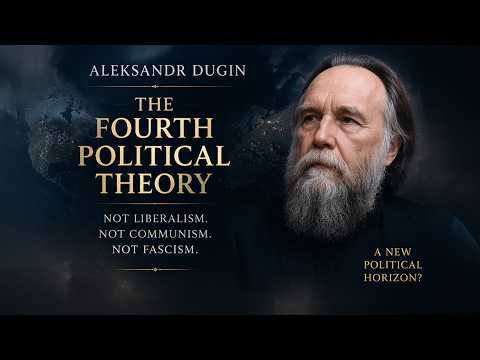
He calls this proposal the Fourth Political Theory. The name is deliberate. It is supposed to come after the three great political theories of modernity.
Dugin is not proposing a restoration of Soviet communism. He explicitly rejects communism. Neither does he present fascism as the answer. And he rejects liberal individualism as the final stage of human political development.
Instead, the Fourth Political Theory is intended as an open project: recover what modernity discarded, examine older civilizations on their own terms, and ask whether human beings can again understand themselves as members of families, peoples, histories, religions, and civilizations rather than merely isolated individuals.
Dasein: The Person in Community
This is where Dugin borrows from the German philosopher Martin Heidegger and his concept of Dasein, literally human existence as “being there,” embedded in the real world. For Dugin, man is not simply an interchangeable economic individual.
We are born into histories, languages, families, places, religions, civilizations.
You do not have to accept Heidegger’s philosophy to recognize something important here. The Bible also refuses to treat human beings as isolated atoms. We are born into families, nations, covenants, communities, and histories.
The more important question is: what ultimately gives those things meaning?
From a Unipolar to a Multipolar World
Dugin believes the future will increasingly belong not to one universal global civilization, but to multiple civilizations. Russia will not simply become America. China will not become Europe. India will not become Russia. Each civilization, he argues, will increasingly draw upon its own historical, religious, and cultural inheritance.
Whether Dugin’s prediction proves completely correct remains to be seen, but the movement toward a more multipolar world is already one of the great geopolitical questions of our time.
A Postmillennial Christian Application
And this is where an application of Dugin to a postmillennial Christian worldview gets exciting. Jesus Christ did not claim to be merely the Logos of Western civilization. He is the Logos, the Word through whom all things were made.
For Christians, every civilization ultimately has to be judged by the lordship of Jesus Christ. But Dugin asks an excellent question: What happens when a civilization abandons its own foundations?
America’s Christian Civilizational Roots
That question becomes especially important for Americans. America is more than a political proposition invented in 1776. Its institutions grew from a much older Christian civilization.
The Mayflower Compact explicitly spoke of establishing a colony for the glory of God and the advancement of the Christian faith. Our inherited ideas about law, liberty, covenant, family, moral responsibility, and limited government did not appear from nowhere.
So perhaps the challenge is not for America to copy Russia, China, or any other civilization. It is to recover what is true and distinctly Christian in our own inheritance.
The Logos and the Cornerstone
Dugin frequently speaks of civilizations recovering their logos, their deepest organizing principle. From a Christian perspective, that idea becomes much more profound.
For us, Logos is not merely a cultural operating system. The Logos is a person: Jesus Christ.
Modernity attempted to build while discarding the cornerstone. The Christian project is not simply to complain about the ruins. It is to build again on the foundation that modernity rejected.
The Kingdom of God and a World in Motion
But Christians have an even larger question to ask: What does this changing world order mean for the advance of the Kingdom of God?
The world order is changing. That does not mean history is ending. It means history is moving. And Christians should understand the world in which God has called us to build.
Why I Wrote This Book
And that is why I wrote Aleksandr Dugin’s Fourth Political Theory in Biblical Perspective. Not because I agree with everything Dugin says. I don’t. But Christians should understand the thinkers who are trying to explain the enormous transition happening around us.
Dugin sees the crisis of modernity, and the Christian has to ask the next obvious question:
What should we build in its place?
And for the postmillennial Christian, that’s not ultimately a question of fear. It’s a question of opportunity.
The Changing World Order Series
Dugin, however, is only one part of the story.
In my Changing World Order series, I also examine Ray Dalio’s theory of rising and declining empires and Samuel Huntington’s prediction of a world increasingly organized around competing civilizations.
Three very different thinkers, three very different ways of understanding the transformation now taking place.
Dalio looks primarily at economics, debt, power, and the cycles of empires. Huntington looks at civilizations, religion, culture, and identity. Dugin looks beneath modern politics itself and asks, “What comes after the ideologies that dominated the last two centuries?”
The Changing World Order series is available on Amazon in paperback and Kindle.
Final Thought
Understand the change, recognize the opportunity, and think carefully about the world that comes next.