Notes on Daniel: Exegesis
By Jay Rogers
Published April 2008
We need to be careful when interpreting Revelation in such as way that we use all scriptural language to interpret the symbolism of this book. The original readers of Revelation (the seven churches of Asia Minor) probably did not have access to all three texts of the “little apocalypse” found in Matthew 24, Mark 13 or Luke 21.
I am taking the preterist view that Revelation was written during the reign of Nero in the persecution of Christians that lasted from 64 to 67 AD. However, the churches of Asia Minor had heard at least one or more Gospel accounts — oral or written — and were aware of Jesus’ teaching on the destruction of the Temple at Jerusalem. It is much more likely that the hearers immediately thought of Daniel’s prophecy, then they did Jesus’ Mount Olivet Discourse. Because the book of Revelation is a letter directed at specific churches, the readers must have had some background information to interpret the symbols. The primary meaning of Revelation is what John intended its hearers to understand it to mean. And to understand that primary meaning, we need to look first at Daniel.
This is one reason why I find it unlikely that the application of John’s Revelation had much to do with events outside of the first century. While Daniel’s prophecy was sealed up until the last days, the meaning of John’s prophecy is revealed (hence the title: Apocalypse or Revelation). Daniel’s prophecy was written and then sealed. Even Daniel did not understand everything he wrote. John’s prophecy was written to seven living churches. The hearers were expected to “understand.” The hearers were expected to “count the number of the beast” — and so on. John’s prophecy was unsealed and there is no indication that John or his hearers would not understand what Revelation was about.
While some preterists have found a lot of parallels between the Mount Olivet Discourse and Revelation, I think it makes much more sense to first recognize John’s use of images from prophecies such as Daniel, Ezekiel and other books of the Old Testament. Once we have done that, then it is also good to see how these same images line up with the Jesus’ Mount Olivet Discourse, whose hearers were also familiar with the Hebrew scriptures. Revelation was written primarily with the Old Testament scriptures in mind. While there is not always a perfect correspondence between the two, the symbols and images are consistent.
We also need to be aware that there are static and fluid images within the prophecy. For instance, the “Lion of the Tribe of Judah” (Revelation 5) turns out to be Christ. There is only one lion in Revelation; but this image also appears in Genesis. The dragon is Satan; just as the serpent is the devil in Genesis. These images are static. The woman in chapter 12 is a virgin; but the woman in chapter 17 is a whore. This image is fluid.
For the most part, with only a few exceptions, if a symbol is found in the Old Testament, we can assume that John meant it to represent the same thing in his prophecy. If there is a large degree of correspondence between the beasts of Daniel and the Beast of Revelation, then we should use this correspondence in our interpretation. It is important to gain a full understanding of Old Testament parallel passages before locking into a static interpretation of the images in Revelation.
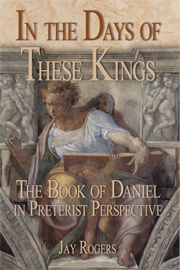
Forerunner - Home » In The Days of These Kings ...
Your comments are welcome!
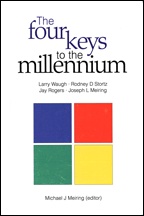
The Four Keys to the Millennium (Book)
Foundations in Biblical Eschatology
By Jay Rogers, Larry Waugh, Rodney Stortz, Joseph Meiring. High quality paperback, 167 pages.
All Christians believe that their great God and Savior, Jesus Christ, will one day return. Although we cannot know the exact time of His return, what exactly did Jesus mean when he spoke of the “sign of His coming” (Mat. 24)? How are we to interpret the prophecies in Isaiah regarding the time when “the earth will be full of the knowledge of the LORD as the waters cover the sea” (Isa. 11:19)? Should we expect a time of great tribulation or reformation and revival before the Lord returns? Is the devil bound now, and are the saints reigning with Christ? Did you know that there are four hermeneutical approaches to the book of Daniel and Revelation? These, and more questions, are dealt with by four authors as they present the four views on the millennium. Each view is then critiqued by the other three authors.
$9.95 — ORDER NOW!
Click here for more information
God's Law and Society (DVD)
Download the Free on-line Study Guide!
God’s Law and Society powerfully presents a comprehensive worldview based upon the ethical system found in the Law of God.
Speakers include: R.J. Rushdoony, George Grant, Howard Phillips, R.C. Sproul Jr., Ken Gentry, Gary DeMar, Jay Grimstead, Steven Schlissel, Andrew Sandlin, Eric Holmberg, and more!
Sixteen Christian leaders and scholars answer some of the most common questions and misconceptions related to this volatile issue:
1. Are we under Law or under Grace?
2. Does the Old Testament Law apply today?
3. Can we legislate morality?
4. What are the biblical foundations of government?
5. Was America founded as a Christian nation?
6. What about the separation of Church and State?
7. Is neutrality a myth?
8. What about non-Christians and the Law of God?
9. Would there be “freedom” in a Christian republic?
10. What would a “Christian America” look like?
Perfect for group instruction as well as personal Bible study.
Ten parts, over four hours of instruction!
Running Time: 240 minutes
Watch over 60 on-line video interviews from God’s Law and Society.
$19.95 — ORDER NOW!
Click here for more information
A Revival Account: Asbury 1970 (DVD)
What is true Revival and Spiritual Awakening?
Discover the answer in this eyewitness account by Dennis Kinlaw, President of Asbury College, Wilmore, Kentucky, who recounts the story of a visitation of the Holy Spirit in 1970. This is the presentation that has continued to spark the flames of Revival in the hearts of people around the world. Contains eyewitness footage from the Revival at Asbury College in 1970 in Wilmore, Kentucky.
Certain to challenge you to greater holiness and a deeper commitment to full-scale revival. Original news and private footage has been included. If you are a student who longs to see a spiritual awakening at your school, you must see this video!
“This simple video does a wonderful job of conveying something of God’s heart and power, Everyone we have ever shown this to has received an immediate impartation of faith for revival and the power of prayer.”
— Bob and Rose Weiner, Weiner Ministries Int’l
Running Time: 40 minutes
$19.95 — ORDER NOW!
Click here for more information
Amazing Grace: The History and Theology of Calvinism (DVD)
Download the Free on-line Study Guide!
Just what is Calvinism?
Does this teaching make man a deterministic robot and God the author of sin? What about free will? If the church accepts Calvinism, won’t evangelism be stifled, perhaps even extinguished? How can we balance God’s sovereignty and man’s responsibility? What are the differences between historic Calvinism and hyper-Calvinism? Why did men like Augustine, Luther, Calvin, Spurgeon, Whitefield, Edwards and a host of renowned Protestant evangelists embrace the teaching of predestination and election and deny free will theology?
This is the first video documentary that answers these and other related questions. Hosted by Eric Holmberg, this fascinating three-part, four-hour presentation is detailed enough so as to not gloss over the controversy. At the same time, it is broken up into ten “Sunday-school-sized” sections to make the rich content manageable and accessible for the average viewer.
Running Time: 257 minutes
$19.95 — ORDER NOW!
Click here for more information
Martin Luther (DVD) 1953 Classic
Niall MacGinnis – Digitally Remastered
The dramatic classic film of Martin Luther’s life was released in theaters worldwide in the 1950s and was nominated for two Oscars. A magnificent depiction of Luther and the forces at work in the surrounding society that resulted in his historic reforming efforts, this film traces Luther’s life from a guilt-burdened monk to his eventual break with the Roman Catholic Church.
In spite of its age, this film continues to be a popular resource to introduce Luther’s life. This historical epic captures the life and times of the greatest figure of the Protestant Reformation with depth and clarity, while giving a glimpse at the private man in the eye of the storm. Luther’s protest against the established order of the Church gave birth to one of the largest religious and cultural movements history and serves as a prime example of how one man’s spiritual convictions can change the course of human events.
Running Time: 105 minutes
$9.95 — ORDER NOW!