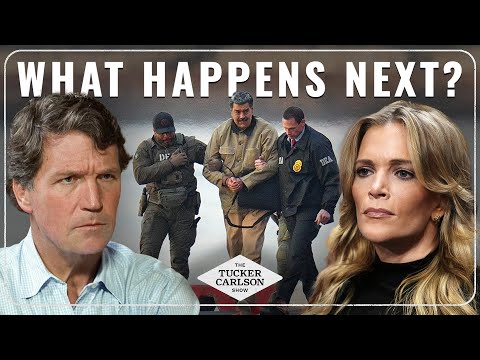
In Tucker Carlson’s most recent monologue, his established rhetorical style (known for blending populist nationalism with a critique of interventionism), showcases several key moments where he likely employs sarcasm, irony, or a “rhetorical trap” to invert the idea that becoming an empire is a “good” thing.
While he appears genuinely pleased by the honesty of the administration admitting its motives (oil/resources), he uses this praise to sarcastically dismantle the moral superiority the U.S. typically claims.
Here are the specific sections where this inversion appears to be happening:
1. The “Thrilling” Nature of Naked Imperialism
Quote:
”He just said it out loud. And there’s something kind of thrilling about that. There’s something thrilling about the honesty there. There’s no fakery… And again, there’s something bracing and refreshing about someone finally telling the truth about why we’re doing what we’re doing.”
The Sarcastic Inversion: On the surface, this sounds like praise. However, Carlson is a staunch “America First” constitutionalist who has historically railed against the “Deep State” and executive overreach. By calling the admission of stealing oil “thrilling” and “refreshing,” he is being ironic. He is not celebrating the theft of resources so much as he is celebrating the death of the “hypocrisy” he despises.
The Trap: He uses this “thrill” to immediately pivot to a devastating conclusion: if we admit we are gangsters for oil, we lose the moral high ground to criticize other “bad” nations.
2. Dismantling the Moral High Ground (Russia and China)
Quote:
”Well, under the rules that we’re now operating under, it’s not wrong. But you can’t point to some abstract principle and say it’s absolutely wrong. … As a matter of principle, can you really say it’s wrong for China to reunify with Taiwan? No, you can’t say that anymore.”
The Sarcastic Inversion: Here, he reveals the true cost of the “thrilling honesty” he just praised. He implies that by accepting the “benefits” of empire (oil), the U.S. has forfeited its soul and its ability to act as a moral arbiter. The “good thing” (getting the oil/honesty) creates a “bad thing” (the inability to morally oppose Putin or Xi Jinping). The sarcasm lies in the implication that the trade-off — becoming a raw empire — actually empowers America’s enemies by validating their behavior.
3. The Death of the Republic
Quote:
”And so we sort of roughly know what will happen. The first thing that’s going to happen is that the energy and the power will vest in the executive and not the legislative branch. Congress will inevitably wither. It already is… The power moves to the executive, to Caesar…”
The Sarcastic Inversion: Carlson frames the shift to empire as a natural “life cycle,” but for a conservative who claims to value the Constitution, the “withering” of Congress and the rise of a “Caesar” is a catastrophe, not a victory. His detached, analytical tone (“That’s a pretty familiar life cycle”) belies the warning: the “Empire” that is supposedly “good” for getting oil is fatal to the American Republic he claims to defend.
4. The “Hate Speech” Official
Quote:
”But this is a guy who actually has a job in the administration saying it’s great. European hate crimes laws are great. Well, first of all, every single one of them is immoral.”
The Sarcastic Inversion: In the second transcript, he mocks the administration official (Rabbi Yehuda Kaplon) by summarizing his view (“saying it’s great”) before immediately hammering it as “immoral.” This is a classic sarcastic setup — feigning understanding of the opposing view to highlight its absurdity before destroying it.
Summary of the Rhetorical Move
Carlson’s argument can be summarized as: ”We are finally being honest about being an empire. Isn’t that great? (Sarcasm). But realize that because we are now openly an empire, our Constitution is dying, our moral authority is dead, and we have no right to lecture Russia or China ever again.”
He praises the symptom (honesty) to highlight the terminal illness of the system (the Republic).
The Dawn of the American Empire: A New Era of Honesty and Power
www.youtube.com/watch?v=7HgM0aI3IK8
The Official Announcement of Empire
What happened a few days ago in Venezuela is not just a big surprise to people who are watching it. It’s not just a kind of exciting fallen foreign policy story. It is effectively the announcement by the US government that our system is changing, that we are now explicitly an empire. We’re an empire. So, of course, the argument has been made — and probably there’s some truth to it — that the United States has been an empire for a long time, for at least the last 80 years since 1945 when we emerged victorious from World War II. Or maybe even 1918 when the British Empire effectively ended. Maybe even 1898 when we got Puerto Rico, and then a few years later, Cuba from the Spanish Empire. You could argue that the United States, like all big, prosperous countries, inevitably became an empire. But the difference between the last 120 years and earlier this week is that we never before admitted it. And now we are.
Every time we’ve gone into foreign countries in Latin America, and really around the world, there has been a pretext for that, usually about human rights or democracy. We say, “We’re not going to put up with this or that government treating its people this way, and we have to go in to stop the tyranny because we are a force for openness and freedom.” There’s been some truth in that, of course, but behind that has been the calculation behind every big foreign policy move made by every big country: How is this good for us? Whether it’s propping up the dollar or getting access to resources, there’s always another reason that we’re doing it. People who are paying close attention know that. Of course, one of the reasons that American troops have been clustered around the Middle East for as long as they have been is not just the Israeli lobby. It’s because there’s an awful lot of energy in the Middle East, oil and gas, and that’s important to our country. We have a stake in making sure it can be extracted and moved around the world.
The End of Pretense
But what makes what happened in Venezuela — taking the head of state out of the presidential palace with Delta Force, bringing him to New York, and putting him on trial — so very different from, say, killing Mosaddegh in 1953 in Iran? The difference is that the US government, the President of the United States, basically just said we’re doing this because of the resources. Venezuela has the largest proven oil reserve in the world. It’s in our hemisphere. It’s going to China? “No, this is our hemisphere. It’s going to go to us.” He just said it out loud. There’s something kind of thrilling about the honesty there. There’s no fakery. No, “We’re the US. We’re not going to put up with that. This is our interest and we’re going to protect it.” That’s what the president said.
For the first time in a long time, there was pretty strong support from the right, from Trump voters, for foreign policy adventurism. Keep in mind a lot of them voted for the president on the basis of his pledge to not start new wars. Well, here is effectively a new conflict and they’re supporting it. Why? Because the president justified it in terms of our national interest. This is good for us. We’re not upholding international law. We’re doing it because we want the oil. And again, there’s something bracing and refreshing about someone finally telling the truth about why we’re doing what we’re doing. The president absolutely told the truth, and that’s great, and you saw an uptick in national pride. Understandably, the US military is actually capable of more than DEI. We can do complicated things and that is something to be proud of.
The Shift from Republic to Empire
But there are pitfalls potentially, and it’s worth considering those because this is a new era. As has been noted, the United States has moved into the imperial phase of empire, leaving the republic and shifting to empire. That’s a pretty familiar life cycle for civilizations, so we sort of roughly know what will happen. The first thing that’s going to happen is that the energy and the power will vest in the executive and not the legislative branch. Congress will inevitably wither. It already is. They were not consulted before we took out the president of Venezuela. They had no role in this whatsoever, despite their constitutional authority. That was ignored as it has been many times in the past. When was the last time Congress did something of note? It’s been a long time.
The power moves to the executive, to Caesar, or the president, or whatever you call him — to the national leader — and that trend will accelerate over time. One implication is that national elections are now everything. It’s always mattered who the president is, but now it matters more than ever because the president has the ability to act unilaterally in the way we just saw. That’s a lesson that every aspiring president will internalize. The next presidential election in 2028 means much more than any presidential election in our history because the power has expanded so dramatically in the office, and once expanded, it never contracts voluntarily.
The Death of International Hypocrisy
The second implication is that now that we’re telling the truth about why nations do what they do, a lot of the arguments that we have relied upon are now moot. Once you say out loud, “We’re grabbing Venezuela because we’re annoyed they’re selling what is our oil to the Chinese, our rival,” it’s kind of hard to make the case that, for example, Russia doesn’t have an interest in what happens in eastern Ukraine. It’s hard to scold Putin for moving into Ukraine. Here’s a great power threatened on its border, and it takes action to protect itself. We’ve been calling that an unprovoked invasion, waging a proxy war against Russia for four years based on the idea that this is illegitimate. You can’t really make that argument anymore.
Why would it be wrong for China to retake Taiwan? The US government already acknowledges that Taiwan is part of China via the One China policy. We suggest we would defend Taiwan against Chinese aggression, but wait a second — Taiwan is Han Chinese. Same people, same language, tons of cultural similarities. We want the microchips in Taiwan. We hope it doesn’t happen because it would give China greater leverage over the United States. But as a matter of principle, can you really say it’s wrong for China to reunify with Taiwan? No, you can’t say that anymore.
This change leaves international bodies in a precarious spot. The UN, the World Health Organization, NATO — do they have any authority at all? Is there a reason to have them once we’ve stopped pretending? Probably not. They’re basically dead men walking. We now live in a world where countries will act in their own interest without apology to the extent they are capable of doing so through force, guile, economic power, or trickery.
The Dangers of Hubris and Unserious Leaders
Far better to think through what this means going forward. The first obvious pitfall is getting over your skis — getting stoned on hubris. Convincing yourself that you have more power than you actually have is the most basic trap in life. The problem with military success is it inspires that. In our government, there’s an entire constellation of foreign lobbies around any president telling him “do this, do that” on behalf of other countries. You could very easily imagine the US government doing what it did in Venezuela in other countries. Maybe in some it will work, but in others, you could wind up in a nuclear war.
That’s why, above all, an empire needs serious men to run it. It needs people who understand the stakes, who understand the burden they are carrying, and who make wise decisions with the national interest ever present in mind. What you don’t want are flighty, emotionally incontinent, silly people on the payroll of foreign nations making the decisions. People like Lindsey Graham, who in the aftermath of Venezuela, is threatening the Ayatollah on TV. It reminds you of getting pulled over for DUI with a drunk passenger screaming at the cop. Lindsey Graham is picking fights we’ll never have to participate in.
It is that exact attitude — that lack of seriousness — that can get you in trouble. Once you strip away all the pretense, you need serious, smart people making the decisions. You do not need harpies screaming about how “my boyfriend’s going to beat you up.” You don’t need bloodthirsty buffoons like Ted Cruz or Laura Loomer trying to lure you into a new conflict. You don’t need Mark Levin telling the president to bomb Qatar, our strongest ally in the region. To Donald Trump’s great credit, he has resisted a lot of that in the last several days.
Pax Americana: Stability as the Goal
The neocons had their candidate ready for Venezuela — Machado, the “Nobel Prize lady,” the “Claus Schwab acolyte.” They were all set to install her, and Donald Trump shut it down. He mocked her at his first press conference. That is the best possible sign that someone has thought this through in a very serious way. It looks like Marco Rubio and JD Vance played a huge role in that, preferring continuity of government by keeping Maduro’s number two, Delcy Rodriguez, in charge.
Why do that? Because tyranny is bad, but chaos is worse. Donald Trump clearly learned the lesson from Iraq and Libya: don’t disband the army, don’t create a vacuum. He arrived at an imperfect but wise solution to keep people in charge who can actually keep the country together. We don’t want a civil war, a migrant crisis, or lost oil fields.
At the height of the Roman Empire, there were very few wars. It was called Pax Romana, the Roman peace. The empire was powerful enough to establish peace, order, and tranquility. Ultimately, an empire’s first job is to preserve stability in the portion of the world over which it rules. The Trump administration seems to understand that.
Geopolitics: The Necessity of a Russian Alliance
The second thing to do is think through where this is going in the next several years. Today, the president announced he is hiking the Pentagon budget from 1 trillion to 1.5 trillion. That is a war budget. It suggests we are moving toward a global or regional war. How do you position yourself for that? You look at a map and ask: Where are the resources? Who do I share a civilization with?
If you think soberly, you arrive at the conclusion that the United States has to have a relationship with Russia to survive. Russia is the largest country in the world with the most resources — energy, minerals, gold. The number one thing you cannot do is allow Russia and China to become a block. If they do, you are facing off against the majority of the world’s population, landmass, and economy. The last administration intentionally drove Russia into an alliance with China. If Donald Trump wants to secure his place in history, it would be to bring Russia back into alliance with the United States. We cannot survive a global conflict if Russia and China are aligned against us.
The Imperial Subject: Domestic Prosperity and Free Speech
The third thing to remember is that a functioning empire benefits from the empire. Rome was a gleaming, prosperous city. If you can’t fix Baltimore, you don’t really have a shot at making Caracas functional. The point of this is to help the seat of empire — our own country. The president has made a huge effort to clean up American cities like Washington DC, and he should keep doing that.
Finally, remember that being an empire can corrupt you. It can make you coarser. You want to retain the fundamental decency of your country even as you expand. You cannot become hardened by the violence you commit on other populations. We saw this with Ashli Babbitt, an unarmed veteran shot in the Capitol, where 535 members of Congress didn’t think it was a big deal because they are desensitized by years of foreign wars.
Americans have to remember that the point of this exercise is to secure the homeland. We are not subjects; we are citizens. The government serves at our pleasure. This posture is hard to keep up during the empire phase because democratic structures wither. You have to push back against an imperial government treating you like a subject. There is no issue on which this is clearer than free speech. It is the only remaining power for most American citizens. You have an inalienable, God-given right to say what you think. If you give that up, you are a slave. This is the red line.
The War on Free Speech at Home: The Call for Censorship
Here’s one example. This, I think, was on CNBC New Year’s Day. Watch this. I know it’s difficult to hear, but it’s time to limit the First Amendment in order to protect it — and quickly, before it’s too late. What do you mean?
“I mean that we need to control the platforms, all the social platforms. We need to stack rank the authenticity of every person that expresses themselves online and take control over what they are saying based on that ranking. The government should [control] social media.”
Yeah. So, here’s a foreigner coming to our country and saying with a straight face, “You need to get rid of the First Amendment because people are using it to criticize my country.” He is sitting on a TV set in New York City lecturing a country that’s not his own about how they’re not allowed to criticize him and how the government should punish them for doing it.
The “Slave” Argument: Jay Collins and Israel
“Cheeky” doesn’t begin to describe it, but he is a foreigner, right? So, okay, you could say, well, he just doesn’t know what the rules are. He’s obviously got a lot of brass to say something like that — a lot of chutzpah — but who cares? I mean, yes, he’s a billionaire. There are a lot of Israeli billionaires who’ve been calling on an Israeli prime minister for censorship in the United States, and it’s offensive, and we should obviously stop giving them any money. We shouldn’t be paying for that. But they’re still not Americans.
Oh, but there are Americans saying that. Here’s one, actually — a career US military officer called Jay Collins. This man is the lieutenant governor of Florida, which is the most conservative state in the union. If you ask Jay Collins, “What are your politics?” He would say, “Oh, of course, I’m straight MAGA Republican. I’m a conservative. I share your values.” This is real. We checked. This is not AI. Watch. Here’s Jay Collins of Florida:
“And here’s a critical thing. You have a right to free speech, but you don’t have the right to harm other people with your words. And you don’t have the right to say things that have really negative, really horrible meanings. When you want people to destroy Israel, that matters.”
Oh, you don’t have the right to say things that people in charge don’t like? You don’t? That’s the whole point. If you don’t have that right, you are a slave, and Jay Collins is your master. Notice, by the way, he didn’t say you can’t attack America. That’s totally fine. Jay Collins, military officer: “No, no, you can’t attack Israel. You can’t call for the destruction of Israel.” Well, of course, you can call for the destruction of any foreign country you want. It’s a staple on Fox News. Lindsey Graham does it every single day. You just can’t call for the destruction of Israel. And that’s a crime? Of course, it’s not a crime. It may be an ugly opinion. It may be an unsustainable argument. You may be an idiot. But you have a God-given right to that opinion and a God-given right to express it.
And this is the only country on planet Earth where you still can. And again, if they try and take that away, you need to have an insurrection against the government because you’re done at that point. An insurrection against the government if they try and take away your right to say what you think, your right to your own conscience. Period. That has to be it right there.
The Imperial Trap: Loyalty to Foreign Nations
It’s fine to attack America, but you can’t attack Israel? This is, by the way, part of the problem with administering an empire. A lot of people — and Jay Collins is clearly one of them — might be good people, might be right about a lot of different things, but they come to identify so strongly with foreign countries that they forget about their own. This was a huge problem during the British Empire. There were tons of colonial military officers and administrators who spent their careers in India and kind of cared a lot more about what happened on the subcontinent than they cared about in England because that’s where they spent their lives. Those are the problems they spent their career solving. So they wound up identifying with foreign countries more than their own.
This is absolutely a feature of empire. It is hard to fight against, but it’s essential that we do fight against it. No, what matters is the United States. That’s who’s paying for this. That’s in whose name these actions are being conducted. The only justification for any of this is to serve American citizens — not the citizens of Israel or Sri Lanka or any other place, Venezuela, but America. So, you’d think this would all be very, very obvious.
The State Department’s Push for European Hate Speech Laws
But somehow — and I actually called around on this and was told, “Oh, it’s not a real position” — but there is a current administration official, an actual official in the executive branch right now, who’s making this case that Americans actually don’t have free speech. Oh, they have a First Amendment, but it turns out that actually, you can’t say anything I don’t like or else you go to jail. This guy’s name is Rabbi Yehuda Kaplon. I don’t think he actually has a congregation… I don’t know what it means to be a rabbi if you don’t actually run a congregation. I actually met him. Seems like a nice guy. But here are his views. And you should keep in mind that the views you’re about to hear are much, much more common than you may realize. Here he is:
“The amount of hate speech that we’ve seen during this time, I mean, it’s off the charts. You look through social media, you see it even on television; the lines, they’re not even blurred anymore. They’re gone. How do you even begin to tackle such a phenomenon? Well, I think we have to have an understanding that, first of all, in this country, we believe very strongly in free speech. It’s the basis in our constitution and we also believe in the freedom of religion. You have to balance that. But you balance that in two ways. Europe has paid speech laws [hate speech laws], probably some of the best on the books, but it’s selectively enforced. So, if you selectively enforce the rule, it’s not going to have any effect whatsoever. And you can see how it’s had no effect in Europe in monitoring and stopping the hate.”
So this guy is something called the “Anti-Semitism Czar.” It’s an office set up by George W. Bush, like most insane, unjustifiable things. An Anti-Semitism Czar at the State Department focused on one specific kind of ethnic hate, not protecting all Americans. There is no “Stop Anti-White Hate Czar,” of course, and there never will be because the same people who are upset about hate are promoting that kind of hate. But whatever, it’s one specific group protected somehow by the United States State Department.
But this is a guy who actually has a job in the administration saying it’s great. European hate crimes laws are great. Well, first of all, every single one of them is immoral. And two, they’re all contrary to the First Amendment. You couldn’t have laws like that here. And three, when you actually look at those laws that Rabbi Yehuda Kaplon is saying are so great, they’re used to suppress Christianity. That’s what they actually are, of course. They suppress creativity, freedom of thought, individual conscience, and the humanity of the populations of European countries.
The Threat to Christianity and National Cohesion
But Christianity is always number one target. So in Finland, for example, one of the lead opposition political leaders is now on trial. Why? Why is she on trial? Because she tweeted a quote from Romans, the Epistle to the Romans by St. Paul. You may have heard of it. It’s a significant book in the New Testament. And in it, he describes basic Christian sexual ethics — you know, like one man, one woman against other forms of sexual expression. That’s Christianity. And that was deemed a hate crime under the law, under those European hate speech laws that Rabbi Yehuda Kaplon is saying we should emulate, but maybe enforce a little tougher, more selectively.
This is what will destroy the country and divide the country and make people hate each other. Whenever the US government protects one group and allows others to be attacked, whenever the US government promotes one group and suppresses another group, it’s prima facie unfair. But it’s also the most divisive thing you could ever do to any country. If you treated your children differently, they wouldn’t hate you; they’d hate each other. And every parent knows that.
So all of this stuff is corrosive to the United States at exactly the moment when national cohesion is going to be essential because there is a rocky road ahead. That’s very obvious. And here you have an administration official calling for hate crimes laws. So the answer has to be no. And it has to be no now more than ever because, once again, we’re entering into a brand new phase with new rules, and all of us are going to have to adapt to those rules. We may support them. We may not support them. But that’s what we’re doing. But in the process, we cannot give up what it means to be American on the most basic level.