Supreme Court Upholds Webster Case
By Editorial Staff
Published March 31, 2008
WASHINGTON, D.C. (EP) – In a decision widely hailed as a blow to legalized abortion on demand, the Supreme Court ruled that states may sharply limit abortion practices. The 5-4 decision upholding a controversial Missouri abortion law stopped short of overturning the Court’s landmark 1973 Roe vs. Wade case which legalized abortion on demand, but left the door open for further abortion restrictions.
The ruling in Webster vs. Reproductive Health Services upheld three state restrictions on abortion. The court ruled that states may forbid abortions in public hospitals or other taxpayer supported facilities, may forbid public employees to perform elective abortions, and may require viability tests for fetuses thought to be at least 20 weeks old.
Writing for the majority, Chief Justice William Rehnquist agreed with a lower court opinion which said testing for viability in second trimester abortions would place an additional financial burden on women seeking abortions.
But Rehnquist said the problem was not with the Missouri law, but with the “viability” standard set forth in Roe v. Wade. “Key elements” of the Roe decision are “not found in the text of the Constitution or in any place else one would expect to find a constitutional principle,” Rehnquist wrote in a stinging criticism of Roe. He added, “We do not see why the state’s interest in protecting potential human life should come into existence only at the point of viability.
Rehnquist suggested that the Court adopt a new standard for evaluating abortion restrictions, focusing on the government’s “interest in protecting potential human life.” Rehnquist noted that there was no need for the court to overturn Roe v. Wade, but recommended, “We would modify and narrow Roe and succeeding cases” given the opportunity.
Justice Antonin Scalia filed a separated but concurring opinion, stating there were “not only valid but compelling” reasons to overturn Roe. He chastised the Court for limiting itself to the “most stingy possible holding today” and called the Court’s action an “indecisive decision.”
Scalia further lambasted his colleagues for refusing to reconsider the Roe vs. Wade decision, concluding, “It thus appears that the mansion of constitutionalized abortion law, constructed overnight in Roe vs. Wade, must be disassembled doorjamb by doorjamb, and never entirely brought down, no matter how wrong it may be … We should decide now, and not insist that we be run into a corner before we grudgingly yield up our judgment.”
Justice Sandra Day O’Connor’s views on abortion have been perceived as ambiguous, and her opinion in the Webster case did little to dispel that ambiguity. Her writing lacked some of the sharp criticism she has previously directed at Roe, but repeated her assertion that the Court’s current “trimester framework” is “problematic.”
O’Connor said that the Court was right in not revisiting Roe and said, “When the constitutional invalidity of a state’s abortion statute actually turns on the constitutional validity of Roe vs. Wade, there will be time enough to re-examine Roe. And to do so carefully.”
In a dissenting opinion, Justice Harry Blackmun, who authored the Court’s majority decision in the 1973 Roe vs. Wade ruling, wrote, “I fear for the future. While for today, at least, the law of abortion stands undisturbed, the signs are very evident and very ominous, and a chill wind blows.”
Fearing that the ruling will invite the states to pass restrictive laws against abortion, Blackmun attacked the majority in Webster for cowardice, deception, disingenuousness and brute force. The ruling, he said, “is filled with winks, and nods, and knowing glances to those who would do away with Roe explicitly.”
A separate dissenting opinion by Justice John Paul Stevens concentrated on the Missouri statute’s preamble, which declared that life begins at conception. Stevens argued that the Missouri Legislature’s statement regarding the beginning of life is religious in nature, and therefore violates the First Amendment’s clause forbidding the establishment of religion.
Stevens wrote, “This conclusion does not, and could not, rest on the fact that the statement happens to coincide with the tenants of certain religions … or on the fact that the legislators who voted to enact it may have been motivated by certain religious considerations … Rather it rests on the fact that the preamble, an unequivocal endorsement of a religious tenant of some but by no means all Christian faiths, serves no identifiable secular purpose.”
The Court has three other abortion cases on its agenda for next session, two that involve parental notice when teens seek abortions, and one on a law requiring that abortion clinics be extensively equipped as medical facilities. Those cases are expected to define further the Court’s shifting attitude toward abortion.
Before it would completely overturn Roe vs. Wade, the Court would probably have to be faced with a law completely banning elective abortion – striking at the heart of Roe’s assertion that a woman has a constitutional right to terminate her pregnancy for any reason, at any time.
Forerunner - Home » The Forerunner Newspaper » Pro-life Articles
Your comments are welcome!
Freedom: The Model of Christian Liberty (DVD)
“Give me liberty or give me death!”
Patrick Henry’s famous declaration not only helped launch the War for Independence, it also perfectly summarized the mindset that gave birth to, and sustained, the unprecedented experiment in Christian liberty that was America.
The freedom our Founders envisioned was not freedom from suffering, want, or hard work. Nor was it freedom to indulge every appetite or whim without restraint—that would merely be servitude to a different master. No, the Founders’ passion was to live free before God, unfettered by the chains of autocracy, shackles that slowly but inexorably bind men when the governments they fashion fail to recognize and uphold freedom’s singular, foundational truth: that all men are created in the image of God, and are thereby co-equally endowed with the right to “life, liberty, and the pursuit of happiness.”
This presentation is a similar call, not to one but many. By reintroducing the principles of freedom that gave birth to America, it is our prayer that Jesus, the true and only ruler over the nations, will once again be our acknowledged Sovereign, that we may again know and exult in the great truth that “where the Spirit of the LORD is, there is liberty” (2 Cor. 3:17).
Welcome to the Second American Revolution!
This DVD features “Liberty: The Model of Christian Liberty” along with “Dawn’s Early Light: A Brief History of America’s Christian Foundations.” Bonus features include a humorous but instructive collection of campaign ads and Eric Holmberg’s controversial YouTube challenge concerning Mitt Romney’s campaign for president.
$14.95 — ORDER NOW!
(We accept all major credit cards and PayPal.)Click here for more information
Amazing Grace: The History and Theology of Calvinism (DVD)
Download the Free Study Guide!
Just what is Calvinism?
Does this teaching make man a deterministic robot and God the author of sin? What about free will? If the church accepts Calvinism, won’t evangelism be stifled, perhaps even extinguished? How can we balance God’s sovereignty and man’s responsibility? What are the differences between historic Calvinism and hyper-Calvinism? Why did men like Augustine, Luther, Calvin, Spurgeon, Whitefield, Edwards and a host of renowned Protestant evangelists embrace the teaching of predestination and election and deny free will theology?
This is the first video documentary that answers these and other related questions. Hosted by Eric Holmberg, this fascinating three-part, four-hour presentation is detailed enough so as to not gloss over the controversy. At the same time, it is broken up into ten “Sunday-school-sized” sections to make the rich content manageable and accessible for the average viewer.
Running Time: 257 minutes
$19.95 — ORDER NOW!
(We accept all major credit cards and PayPal.)Click here for more information
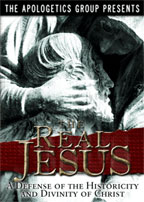
The Real Jesus: A Defense of the Historicity and Divinity of Christ (DVD)
Who is the Real Jesus?
Ever since the dawn of modern rationalism, skeptics have sought to use textual criticism, archeology and historical reconstructions to uncover the “historical Jesus” — a wise teacher who said many wonderful things, but fulfilled no prophecies, performed no miracles and certainly did not rise from the dead in triumph over sin.
Over the past 100 years, however, startling discoveries in biblical archeology and scholarship have all but vanquished the faulty assumptions of these doubting modernists. Regrettably, these discoveries have often been ignored by the skeptics as well as by the popular media. As a result, the liberal view still holds sway in universities and impacts the culture and even much of the church.
The Real Jesus explodes the myths of these critics and the movies, books and television programs that have popularized their views. Presented in ten parts — perfect for individual, family and classroom study — viewers will be challenged to go deeper in their knowledge of Christ in order to be able to defend their faith and present the truth to a skeptical modern world – that the Jesus of the Gospels is the Jesus of history — “the same yesterday, today and forever” (Hebrews 13:8). He is the real Jesus.
Speakers include: George Grant, Ted Baehr, Stephen Mansfield, Raymond Ortlund, Phil Kayser, David Lutzweiler, Jay Grimstead, J.P. Holding, and Eric Holmberg.
Ten parts, over two hours of instruction!
Running Time: 130 minutes
$19.95 — ORDER NOW!
(We accept all major credit cards and PayPal.)Click here for more information
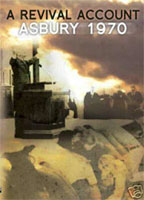
A Revival Account: Asbury 1970 (DVD)
What is true Revival and Spiritual Awakening?
Discover the answer in this eyewitness account by Dennis Kinlaw, President of Asbury College, Wilmore, Kentucky, who recounts the story of a visitation of the Holy Spirit in 1970. This is the presentation that has continued to spark the flames of Revival in the hearts of people around the world. Contains eyewitness footage from the Revival at Asbury College in 1970 in Wilmore, Kentucky.
Certain to challenge you to greater holiness and a deeper commitment to full-scale revival. Original news and private footage has been included. If you are a student who longs to see a spiritual awakening at your school, you must see this video!
“This simple video does a wonderful job of conveying something of God’s heart and power, Everyone we have ever shown this to has received an immediate impartation of faith for revival and the power of prayer.”
— Bob and Rose Weiner, Weiner Ministries Int’l
Running Time: 40 minutes
$19.95 — ORDER NOW!
(We accept all major credit cards and PayPal.)Click here for more information
Dr. Francis Schaeffer - How Should We Then Live? (DVD)
Special Two-Disc Set!
After 40 years of intense study and world-wide ministry, Dr. Francis Schaeffer completed his crowning work of scholarship – to present profound truths in simple film language. Dr. Schaeffer’s brilliant analysis of the past and predictions for current trends have proven so uncannily accurate that this amazing series still feels contemporary almost three decades after its initial release. Ultimately, Schaeffer concludes that man’s only hope is a return to God’s Biblical absolute, the truth revealed in Christ through the Scriptures.
Available for the first time on DVD, this documentary spectacular also includes intimate in-depth conversations with Francis and Edith Schaeffer. With the on-disc study guide, this presentation forms a unique course of comprehensive study. While this series forms an innovative analysis of the past, this outstanding work is more than history. Each episode focuses on a significant era, yet speaks clearly to 21st-century man with answers for modern problems.
$49.95 — ORDER NOW!
(We accept all major credit cards and PayPal.)