Jay Rogers
International Director:
Jay Rogers

Jay Rogers

The Forerunner

Mexico Partially Restores Religious Freedom

By Editorial Staff
Published August 1992

The Lower Chamber of the Mexican Congress recently approved a “Law on Religious Associations and Public Worship” that attempts, at least partially, to restore religious liberties in that country.

The new law recognizes a church’s right to own private property (Art. 16); for its ministers to wear clerical clothing in public; have its legal status recognized by the government (Art. 7); and have a separate legal existence from the state (Art. 1). It also guarantees the individual the right “not to be compelled to contribute with money or goods to support an association, church or any religious group,” nor be compelled to “participate or contribute in the same way in rites, ceremonies, festivals, services or acts of religious cults” (Art. 2(d)). The sixth article of the law establishes that “religious associations are equal before the law in rights and obligations.”

This translates into no special privileges for the Catholic Church or a state-established religion. However, this law still expresses the religious intolerance such as that which took place when the state promoted the predominance of the Catholic Church in the past century. On the negative side, the new law bans religious institutions from owning TV and radio stations or newspapers, allowing only the use of them under certain conditions and licenses (Art. 16, second paragraph). Likewise, public religious worship must have consent of the state (Art. 22).

The new law hinders liberty of association, movement, speech and religious freedom that the Mexican Constitution recognizes. For instance, the new law considers any religious association that has not been registered with the government to be a “punishable infringement.” Clearly such a provision, besides being impracticable, is unconstitutional. The state attributions under the new law go as far as to make it the “arbiter” in conflicts between religious groups!

Despite the above mentioned insufficiencies, the new regime of religious freedom in Mexico is clearly superior to the one in effect until now. The new law amends several articles of the 1917 Mexican Constitution, particularly the Article 130. In its original form the Constitution’s Article 130 established the “intervention” of federal powers in “worship matters and external discipline.” Likewise, it did not recognize the legal status of any religious association; granted the state legislatures the right to establish the “top number” of ministers of certain religious groups; forbade the ministers of these groups from “criticizing” the government; and severely restrained the private property of churches.

Congressman Amador Rodriguez Lozano, president of the Human Rights Committee of the Lower Chamber, commented on the difficulty of dealing and approving a law of this type and defined the issue of church and state relations as “untouchable.”

Rodriguez describes it as a question of “two territories – God’s and Caesar’s – on which the same and free people journeys.” Rodriguez adds that “the Mexican state has learned the importance of recognizing and placing in its strictly spiritual dimension, the role of belief and attitudes of the people’s profound religious faith.”

“The state knows perfectly,” he says, “that the concept of faith is valid in the people, not only in the religious aspect, but in the issues regarding the institutional trust in civil life.”

President Carlos Salinas de Gortari affirmed this by expressing his “respect and support” for all religious groups in that country.

Mañuel Gomez Granados, director of the Mexican Institute of Christian Social Doctrine, which is connected to the Catholic Church, comments that the modifications to Article 130 “will facilitate the development of a new evangelization in the country only if the (Catholic) Church assumes its responsibility; because if it does not, it is irrelevant that the law changes.” The Catholic Church will continue to be “fossilized in some aspects, anchored in the past, without moral strength to transform the people.“1

Referring to evangelization, Gomez Granados adds: “If we are honest people, we will say that the evangelization in our country has been a weak, deficient one, a superficial polish, when evangelization must change the innermost parts of the human being, giving him a lifestyle of total confidence in God, of austerity, or work.“2

Currently, religious plurality in Mexico is expressed by the existence of around 175 different religious groups. The Protestants are, after the Catholics, the second largest group, with 17 million adherents.

“Within the modernization of religious life as a social process,” writes G. de Jesus Huchim Hoyoc, exists a “wide and open religious market which means that every church accepts the challenges of competition, productivity and efficacy. Each denomination will have to demonstrate or reaffirm its competitiveness in proselytism. This is particularly applicable in the case of the Catholic Church.”

Huchim Koyoc continues, “The state has no business protecting the inefficiency of any religious association in keeping or increasing the number of its members (or quota in the religious market). The dynamics of each church, its capability to maintain or increase its participation in such a market, must depend fundamentally on its own effort, and not on some form of state protectionism“3

This way, Mexico advances toward the consolidation of a regime which will allow an authentic and full religious plurality, will strengthen its democratic process and will preserve the civil and political liberties so dear to the Mexican people.

1 David Perez Calleja, El Nacional, July 8, 1992.
2 Ibid.
3 El Nacional, July 14, 1992.


Forerunner - Home » The Forerunner Newspaper » Latin America

Your comments are welcome!

Textile Help

Amazing GraceAmazing Grace: The History and Theology of Calvinism (DVD)

Download the Free on-line Study Guide!

Just what is Calvinism?

Does this teaching make man a deterministic robot and God the author of sin? What about free will? If the church accepts Calvinism, won’t evangelism be stifled, perhaps even extinguished? How can we balance God’s sovereignty and man’s responsibility? What are the differences between historic Calvinism and hyper-Calvinism? Why did men like Augustine, Luther, Calvin, Spurgeon, Whitefield, Edwards and a host of renowned Protestant evangelists embrace the teaching of predestination and election and deny free will theology?

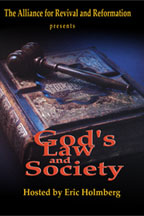
This is the first video documentary that answers these and other related questions. Hosted by Eric Holmberg, this fascinating three-part, four-hour presentation is detailed enough so as to not gloss over the controversy. At the same time, it is broken up into ten “Sunday-school-sized” sections to make the rich content manageable and accessible for the average viewer.

Running Time: 257 minutes

$19.95 — ORDER NOW!

Click here for more information


The Beast of Revelation IdentifiedThe Beast of Revelation: Identified (DVD)

Who is the dreaded beast of Revelation?

Now at last, a plausible candidate for this personification of evil incarnate has been identified (or re-identified). Ken Gentry’s insightful analysis of scripture and history is likely to revolutionize your understanding of the book of Revelation — and even more importantly — amplify and energize your entire Christian worldview!

Historical footage and other graphics are used to illustrate the lecture Dr. Gentry presented at the 1999 Ligonier Conference in Orlando, Florida. It is followed by a one-hour question and answer session addressing the key concerns and objections typically raised in response to his position. This presentation also features an introduction that touches on not only the confusion and controversy surrounding this issue — but just why it may well be one of the most significant issues facing the Church today.

Ideal for group meetings, personal Bible study — for anyone who wants to understand the historical context of John’s famous letter “… to the seven churches which are in Asia.” (Revelation 1:4)

Running Time: 145 minutes

$17.95 — ORDER NOW!

Click here for more information


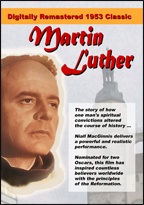
Martin Luther (DVD) 1953 Classic

Niall MacGinnis – Digitally Remastered

The dramatic classic film of Martin Luther’s life was released in theaters worldwide in the 1950s and was nominated for two Oscars. A magnificent depiction of Luther and the forces at work in the surrounding society that resulted in his historic reforming efforts, this film traces Luther’s life from a guilt-burdened monk to his eventual break with the Roman Catholic Church.

In spite of its age, this film continues to be a popular resource to introduce Luther’s life. This historical epic captures the life and times of the greatest figure of the Protestant Reformation with depth and clarity, while giving a glimpse at the private man in the eye of the storm. Luther’s protest against the established order of the Church gave birth to one of the largest religious and cultural movements history and serves as a prime example of how one man’s spiritual convictions can change the course of human events.

Running Time: 105 minutes

$9.95 — ORDER NOW!

Click here for more information


A Revival Account: Asbury 1970 (DVD)

What is true Revival and Spiritual Awakening?

Discover the answer in this eyewitness account by Dennis Kinlaw, President of Asbury College, Wilmore, Kentucky, who recounts the story of a visitation of the Holy Spirit in 1970. This is the presentation that has continued to spark the flames of Revival in the hearts of people around the world. Contains eyewitness footage from the Revival at Asbury College in 1970 in Wilmore, Kentucky.

Certain to challenge you to greater holiness and a deeper commitment to full-scale revival. Original news and private footage has been included. If you are a student who longs to see a spiritual awakening at your school, you must see this video!

“This simple video does a wonderful job of conveying something of God’s heart and power, Everyone we have ever shown this to has received an immediate impartation of faith for revival and the power of prayer.”
— Bob and Rose Weiner, Weiner Ministries Int’l

Running Time: 40 minutes

$19.95 — ORDER NOW!

Click here for more information


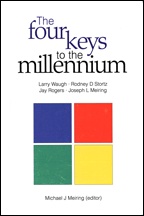
The Four Keys to the Millennium (Book)

Foundations in Biblical Eschatology

By Jay Rogers, Larry Waugh, Rodney Stortz, Joseph Meiring. High quality paperback, 167 pages.

All Christians believe that their great God and Savior, Jesus Christ, will one day return. Although we cannot know the exact time of His return, what exactly did Jesus mean when he spoke of the “sign of His coming” (Mat. 24)? How are we to interpret the prophecies in Isaiah regarding the time when “the earth will be full of the knowledge of the LORD as the waters cover the sea” (Isa. 11:19)? Should we expect a time of great tribulation or reformation and revival before the Lord returns? Is the devil bound now, and are the saints reigning with Christ? Did you know that there are four hermeneutical approaches to the book of Daniel and Revelation? These, and more questions, are dealt with by four authors as they present the four views on the millennium. Each view is then critiqued by the other three authors.

$9.95 — ORDER NOW!

Click here for more information

RSS
Use an RSS Feed Reader?
Subscribe to
The Forerunner

Have The Forerunner Weblog sent straight to your inbox!


YouTube
The Forerunner TV!

Featured Product
If you like the articles on this website, you may also be interested in:

Featured Articles

Live Seminar!

Real Jesus
The Real Jesus Update

The Real Jesus:
A Defense of the Historicity and Divinity of Jesus

is a 130-minute presentation debunking the so-called “historical Jesus” of liberal theologians, whose myths are repeated endlessly in the popular media. You can order this series on DVD, read the complete script, and view clips on-line...
continued ...