When Old Is New And New Is Old
By P. Andrew Sandlin
Published May 2008
People ignorant of history are at a serious disadvantage in assessing ideas, philosophies, teachings, ideologies, and movements. They often have the bad habit of thinking their beliefs and practices are somehow historic, and that anybody who introduces different ideas and practices must of necessity be inventing something new. We might call this trait modernistic elitist snobbery. These are the people who quite often read only twentieth-century books, and automatically think anything recent must be right.
Perhaps no group is more guilty of this modernistic elitist provincialism than contemporary Christians. It appears as though many believe church history began in 1920. If anybody brings up Puritan, medieval, English Baptist, or Protestant ideas from an earlier time, he is charged with introducing some new doctrine. The provincialists, poor souls, have never escaped from Plato’s cave.
Some examples: some who hold to the necessity of an “altar call” somehow feel that those orthodox Christians who oppose it are somehow “modernistic”; but quite the opposite is true: from the standpoint of church history, the “anxious seat” is a modernistic invention. All students of church history should know that this practice-invented probably by Charles Finney or someone contemporary to him and calculated to procure immediate results and circumvent the operation of the Holy Spirit (Finney, interestingly enough, did not believe regeneration was a supernatural work; thus the Holy Spirit was not needed)-was known no time before the nineteenth century. It was not found in the early church, the patristic church, the medieval church, or the Protestant church. It is not supported by the Bible; it is not supported by history. It is, consequently, a modern invention. My point is not to oppose “altar calls,” but to confute the contention of some adherents of this practice that deviation from it is some modern invention.
The advent of “house churches” may be the wave of the future. Those tenaciously embracing the institutional church sometimes give the impression there is something “mod” about the house-church movement.
They haven’t been reading their Bibles. New Testament evidence reveals clearly that in the early-church period there were no other churches but house churches; and if there were others, they are not mentioned. The only thing modernistic in connection with the house-church movement is the ideas of those so tied to the institutional church that they can’t (apparently) read the New Testament. We may solidly surmise that affection of Christians for buildings is a Roman Catholic sentiment. No one, of course, denies that before the rise of Roman Catholicism churches did meet in buildings larger than houses-or at least in very large houses; notwithstanding, the preoccupation with church buildings seems to coincide all too obviously with the Roman Catholic infatuation with “cathedrals of worship,” icons, and “sacramental beauty.” This opinion may be difficult to prove, but it is probably even more difficult to disprove. But to suggest to modern Christians that their preference for church buildings over house churches may reflect Romish ideas rather than the New Testament Faith is likely to invite emotional (but insupportable) outbursts of opposition. To them, old (meeting in houses) is new, since it is new to their provincial minds.
Many of the Church of Christ and Baptist persuasion perceive any deviation from their cherished denominational title as some modern invention. Some from both denominational groups are even convinced their titles are somehow Biblical! They may as well admit, however, that, from the evidence we have in the New Testament, no churches had any titles whatsoever, “Baptist” or “Church of Christ” or anything else. The fact that “churches of Christ” or “churches of God” appears in the Bible in no way indicates these were names given to them. To the best of our knowledge, New Testament churches did not have names of any kind. But those of each persuasion who are convinced the name is so important will nonetheless admit the most important aspect of their Faith is not their name but their doctrine. Oddly enough, however, these same people dislike the idea of deviation from their name!
But they can’t have it both ways. Either these names were not titles from New Testament churches and the doctrine is most important, or the name and title are more important than the doctrine no matter what the New Testament says. They do not prefer to affirm the latter, because it may give rise to accusations that they no longer affirm the authority of the Bible. So they play both sides of the fence. Consequently, they may charge that a return to New Testament ideas constitutes “modernism”; but they don’t realize that the attachment to church titles is a relatively late invention in church history. According to those standards, they are the “modernists.”
Beware when old is new and new is old.
Forerunner - Home » The Puritan Storm
Your comments are welcome!
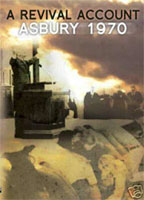
A Revival Account: Asbury 1970 (DVD)
What is true Revival and Spiritual Awakening?
Discover the answer in this eyewitness account by Dennis Kinlaw, President of Asbury College, Wilmore, Kentucky, who recounts the story of a visitation of the Holy Spirit in 1970. This is the presentation that has continued to spark the flames of Revival in the hearts of people around the world. Contains eyewitness footage from the Revival at Asbury College in 1970 in Wilmore, Kentucky.
Certain to challenge you to greater holiness and a deeper commitment to full-scale revival. Original news and private footage has been included. If you are a student who longs to see a spiritual awakening at your school, you must see this video!
“This simple video does a wonderful job of conveying something of God’s heart and power, Everyone we have ever shown this to has received an immediate impartation of faith for revival and the power of prayer.”
— Bob and Rose Weiner, Weiner Ministries Int’l
Running Time: 40 minutes
$19.95 — ORDER NOW!
Click here for more information
Dr. Francis Schaeffer - A Christian Manifesto (DVD)
That Swiss Hermit Strikes Again!
Dr. Schaeffer, who was one of the most influential Christian thinkers in the twentieth century, shows that secular humanism has displaced the Judeo-Christian consensus that once defined our nation’s moral boundaries. Law, education, and medicine have all been reshaped for the worse as a consequence. America’s dominant worldview changed, Schaeffer charges, when Christians weren’t looking.
Schaeffer lists two reasons for evangelical indifference: a false concept of spirituality and fear. He calls on believers to stand against the tyranny and moral chaos that come when humanism reigns-and warns that believers may, at some point, be forced to make the hard choice between obeying God or Caesar. A Christian Manifesto is a thought-provoking and bracing Christian analysis of American culture and the obligation Christians have to engage the culture with the claims of Christ.
$19.95 — ORDER NOW!
Click here for more information
Amazing Grace: The History and Theology of Calvinism (DVD)
Download the Free on-line Study Guide!
Just what is Calvinism?
Does this teaching make man a deterministic robot and God the author of sin? What about free will? If the church accepts Calvinism, won’t evangelism be stifled, perhaps even extinguished? How can we balance God’s sovereignty and man’s responsibility? What are the differences between historic Calvinism and hyper-Calvinism? Why did men like Augustine, Luther, Calvin, Spurgeon, Whitefield, Edwards and a host of renowned Protestant evangelists embrace the teaching of predestination and election and deny free will theology?
This is the first video documentary that answers these and other related questions. Hosted by Eric Holmberg, this fascinating three-part, four-hour presentation is detailed enough so as to not gloss over the controversy. At the same time, it is broken up into ten “Sunday-school-sized” sections to make the rich content manageable and accessible for the average viewer.
Running Time: 257 minutes
$19.95 — ORDER NOW!
Click here for more information
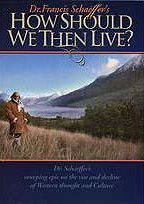
Dr. Francis Schaeffer - How Should We Then Live? (DVD)
Special Two-Disc Set!
After 40 years of intense study and world-wide ministry, Dr. Francis Schaeffer completed his crowning work of scholarship – to present profound truths in simple film language. Dr. Schaeffer’s brilliant analysis of the past and predictions for current trends have proven so uncannily accurate that this amazing series still feels contemporary almost three decades after its initial release. Ultimately, Schaeffer concludes that man’s only hope is a return to God’s Biblical absolute, the truth revealed in Christ through the Scriptures.
Available for the first time on DVD, this documentary spectacular also includes intimate in-depth conversations with Francis and Edith Schaeffer. With the on-disc study guide, this presentation forms a unique course of comprehensive study. While this series forms an innovative analysis of the past, this outstanding work is more than history. Each episode focuses on a significant era, yet speaks clearly to 21st-century man with answers for modern problems.
$49.95 — ORDER NOW!
Click here for more information
Martin Luther (DVD) 1953 Classic
Niall MacGinnis – Digitally Remastered
The dramatic classic film of Martin Luther’s life was released in theaters worldwide in the 1950s and was nominated for two Oscars. A magnificent depiction of Luther and the forces at work in the surrounding society that resulted in his historic reforming efforts, this film traces Luther’s life from a guilt-burdened monk to his eventual break with the Roman Catholic Church.
In spite of its age, this film continues to be a popular resource to introduce Luther’s life. This historical epic captures the life and times of the greatest figure of the Protestant Reformation with depth and clarity, while giving a glimpse at the private man in the eye of the storm. Luther’s protest against the established order of the Church gave birth to one of the largest religious and cultural movements history and serves as a prime example of how one man’s spiritual convictions can change the course of human events.
Running Time: 105 minutes
$9.95 — ORDER NOW!