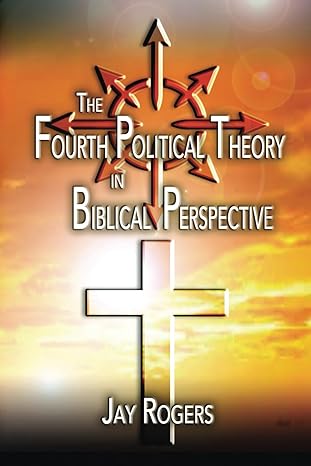
The Fourth Political Theory in Biblical Perspective: An Introduction

New Book by Jay Rogers!
New Book Available on Amazon. Click on link.

The Fourth Political Theory in Biblical Perspective

Imagine if you lived in Western Europe 500 years ago and someone told you that an explorer had just circumnavigated the world. There were now newly discovered vast continents to the West and East and huge civilizations that had never encountered each other before. What if they tried to explain the coming changes in world trade, world reserve currencies, joint-stock investment capitalism, global banking systems, the Internet? What about the Protestant Reformation, Enlightenment science, constitutional government, Liberal democratic republics? You might have scratched your head and thought you were talking to a crazy person.

Things we take as mundane reality today would have been thought of as wonders just a few years ago. Few people today understand that we are on the cusp of a monumental shift in worldview, politics, and civilizational culture that is at least as great as the changes we saw in the West beginning in the 1500s. Of course, change happens all the time, but most live as though the world we see is the only one possible. Innovations on the level described above are inconceivable. These coming tectonic quakes will shift civilizational politics. These changes are coming as fast as they began to come 500 years ago.

Are you ready, Christian, to weather the earth-shaking changes? Are you ready to lead?

This book came about because I read three books that helped me form a more cohesive worldview on geopolitics.

Read more

One China: Which is it?

Poll shows 48.9% support independence Taipei Times Sep 2, 2023 — A poll released by the Taiwanese Public Opinion Foundation yesterday showed 48.9 percent of Taiwanese support obtaining formal national independence. Over 80% of Taiwanese favor maintaining status quo…

Read more

Daniel 12 in Preterist Perspective

Does Daniel 12:2,3,12 refer to the General Resurrection and the Final Judgment?

While the allusion to Daniel 12:1 in Matthew 24:21,22 strongly points to a fulfillment by AD 70, the next two verses in Daniel 12:2,3 seem to refer to the General Resurrection, the Last Judgment and the Everlasting Kingdom. In fact, Daniel 12:2,3 is one of the most frequently used proof texts for these eschatological events. This is certainly one of the most difficult passages in Daniel to interpret from a preterist perspective.

Does Daniel 12:1 speak of events in the first century only to jump thousands of years in the future to speak of events at the end of human history in Daniel 12:2,3?

If we look at how Daniel uses parallelism throughout the chapter, it becomes apparent that the purpose is not to point to a General Resurrection, but to say that the prophecy would be fulfilled long after Daniel had died in the “end of days.”

In short, the passage shows that Daniel and the Jews of that era certainly believed in General Resurrection and a Final Judgment, and the language does refer to these two great events that are yet in our future. But the allusion to a final Resurrection and Judgment is used to delineate the “wise” from the “wicked” – between those who would “understand” the prophecy and receive their inheritance of everlasting life – and those who would not understand and suffer “everlasting contempt” at the Final Judgment. The confusing portion from a preterist viewpoint is the elaboration on what will happen “at that time,” which then speaks of the dead awakening.

Read more

Suggested products