The article below the map and the timelines deals with an objection to the preterist perspective on Revelation 11:2.
But leave out the court which is outside the temple, and do not measure it, for it has been given to the Gentiles. And they will tread the holy city underfoot for forty-two months (Revelation 11:2).
How could the city of Jerusalem have been “trampled underfoot” by the Gentiles, if the Roman armies only entered the city in the last six months of the three-and-a-half year First Roman Jewish War?
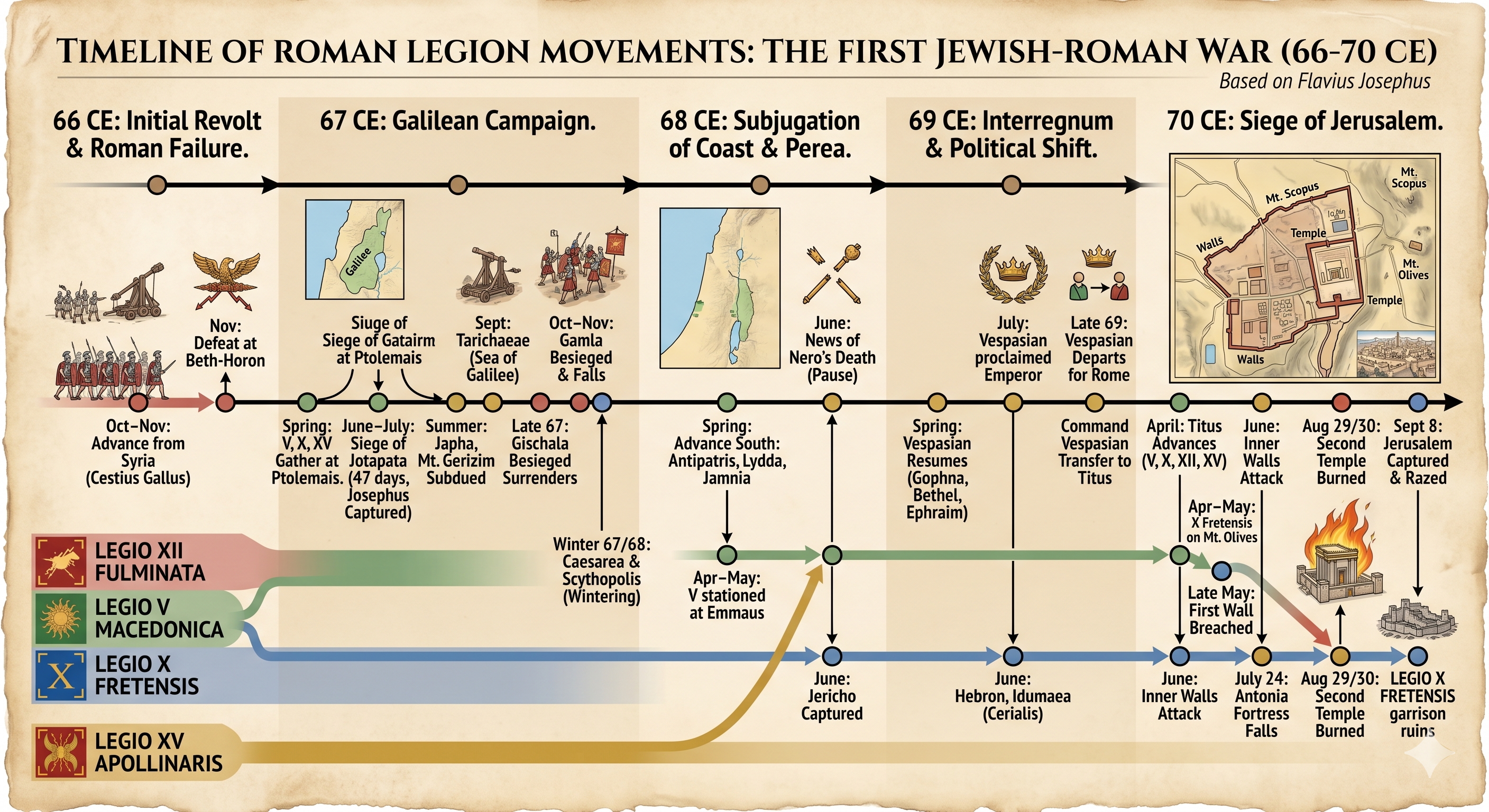
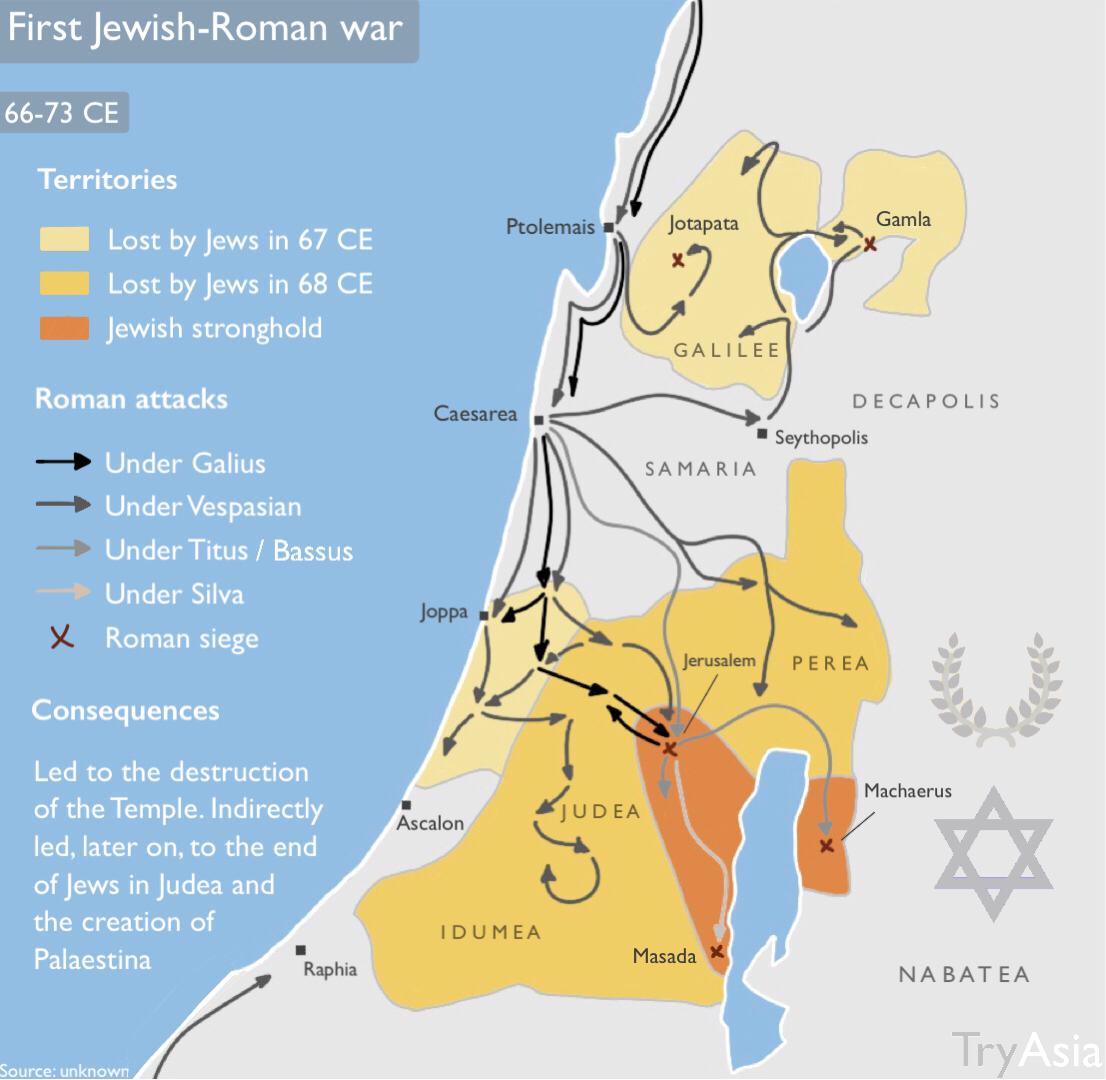
This timeline outlines the movements of Roman legions — primarily Legio V Macedonica, X Fretensis, XV Apollinaris, and the ill-fated XII Fulminata — during the First Jewish-Roman War (AD 66 – 70) based on the account of Flavius Josephus. 1, 2.
AD 66: Initial Revolt and Roman Failure 1., 2., 3
- May 66: The revolt begins in Caesarea and spreads to Jerusalem; the Roman garrison in Jerusalem is killed.
- October – November 66: Cestius Gallus, Legate of Syria, leads the XII Fulminata and auxiliary troops from Syria into Judea.
- November 66: Cestius is defeated by Jewish forces at the Pass of Beth-Horon while retreating. The XII Fulminata suffers heavy casualties and loses its eagle standard. 1, 2, 3, 4, 5.
AD 67: The Galilean Campaign (Vespasian) 1, 2
Vespasian is appointed commander and gathers three legions (V, X, XV) at Ptolemais (Akko). 1
- Spring (May) 67: Roman troops invade Galilee. Sepphoris surrenders and is garrisoned.
- June – July 67: Jotapata (Yodfat) is besieged by Vespasian with ~60,000 men, resulting in the city’s fall after 47 days and the capture of Josephus.
- Summer 67: Titus captures Japha and subdues Mount Gerizim (Samaria).
- September 67: Titus captures Tarichaeae on the Sea of Galilee. Surviving rebels are executed or sold into slavery.
- October – November 67: Gamla (Golan) is besieged and falls to the Romans after 6 weeks.
- Late 67: Gischala surrenders. John of Gischala flees to Jerusalem.
- Winter 67/68: Roman troops winter in Caesarea and Scythopolis. 1, 2., 3, 4, 5
AD 68: Subjugation of the Coast and Perea 1
- Spring 68: Vespasian moves south, capturing Antipatris, Lydda, and Jamnia.
- April – May 68: Roman troops move to Emmaus (Legio V stationed here) and Bethleptepha, raiding Idumaea.
- June 68: Romans capture Jericho and garrison it.
- June 68: News of Nero’s death arrives; Vespasian pauses the advance on Jerusalem to await developments. 1, 2, 3
AD 69: Interregnum and Political Shift
- Spring 69: Vespasian resumes campaigns in the highlands, taking Gophna, Bethel, and Ephraim.
- June 69: Romans under Cerialis destroy Hebron and burn upper Idumaea.
- July 69: Vespasian is proclaimed emperor in Caesarea.
- Late 69: Vespasian departs for Rome, leaving Titus in command to finish the war. 1
AD 70: The Siege of Jerusalem (Titus)
Titus gathers four legions (V, X, XII, XV) for the final assault. 1, 2., 3.
- April (Passover) 70: Titus advances from Caesarea and sets up camp at Mount Scopus (Northeast of Jerusalem).
- April – May 70: The Legio X Fretensis sets up on the Mount of Olives. The First (outer) Wall is breached in late May.
- June 70: Romans build siege works and attack the inner walls.
- July (July 24) 70: The Antonia Fortress is taken and destroyed.
- August (August 29/30) 70: The Second Temple is burned, and the Romans occupy the Temple Mount.
- September 70: The Upper City is taken. Jerusalem is fully captured and razed on or around September 8th. 1, 2, 3, 4
Following the fall of Jerusalem, the Legio X Fretensis is left to garrison the ruins of the city.
The Objection: Did the Gentiles trample the city of Jerusalem for 42 months?
Recently, a friend of mine challenged me on my preterist reading of Revelation 11:2. The objection is that although the First Jewish War lasted roughly 42 months — Spring of AD 67 to the end of September AD 70 — the Roman troops were never inside the city until sometime in the last six months. This is a significant objection because Revelation 11:2 closely parallels Luke 21:24.
Revelation 11:2 – But the court which is without the temple leave out, and measure it not; for it is given unto the Gentiles: and the holy city shall they tread under foot forty and two months.
These “forty-two months” during which the nations shall tread the holy city under foot are identical with the “times of the nations” referred to in Luke 21:24: “They shall fall by the edge of the sword and shall be led captive into all the nations; and Jerusalem shall be trodden down by nations until the times of the nations be fulfilled” (Milton Terry, Commentary on the Apocalypse).
This judgment came because the testimony of Jesus was despised and rejected by the unbelieving Jews. They persecuted Christ’s Apostles unto death. If it can be demonstrated that Jesus is speaking in the Mount Olivet Discourse of the judgement on the Jews that came in the 42 month war and destruction of Jerusalem, then the language of Revelation 11;2 might be interpreted in a similar manner.
The Answer: The “Holy City” in Scripture often includes both Jerusalem and the other lands and cities promised to the people of God.
Hugo Grotius in his Annotations on the New Testament explains the difference of language between Matthew, Mark and Luke dealing with the “Abomination of Desolation” in the Mount Olivet Discourse as follows:
“Therefore when you see the ‘abomination of desolation,’ spoken of by Daniel the prophet, standing in the holy place” (whoever reads, let him understand), then let those who are in Judea flee to the mountains.
“Standing in the holy place.” Mark has, “where it ought not,” that is, not within the Temple itself – for that would not be a sign of the coming destruction, but the destruction itself already present – but in view of the Temple, on the ground surrounding the city, which ought to be sacred to God alone and not to the gods of the nations.
Thus the “regions around Jerusalem” are also described in the Psalms as especially sacred [cf. Psalms 125:1-2]. Likewise Alexander, the son of Antiochus, wished the sanctity and privileges of Jerusalem to extend “even to its borders,” as Josephus records. Similarly Demetrius, in a decree preserved in 1 Maccabees 10:31, declares: “Let Jerusalem be holy and free, and its borders likewise.” Josephus says that Demetrius granted the right of refuge not only in the Temple but also in the places belonging to it. A similar example is found in Tacitus, who notes that certain emperors extended the sanctity of a temple for two miles around it.
For this reason, when Vitellius planned to lead his forces through Judea against Aretas, the Jews, as Josephus reports, begged him not to pass through their land, because it was not their custom to allow images to be carried into it, and many such images were attached to military standards. Thus they declared it unlawful for standards to appear on the soil of Judea because of the images they bore. Vitellius complied with this request, and this occurred not long after Christ spoke these words.
To summarize:
From a preterist perspective, the “treading under foot” began the moment Vespasian’s legions entered Galilee and Judea in the spring of AD 67. If the “Holy City” is interpreted strictly as the city of Jerusalem, my friend’s objection holds: the Romans didn’t breach the city until AD 70. However, the following evidence supports the interpretation that the 42 months refers to the entirety of the Holy Land being trampled by Gentile boots.
1. The Sanctity of the Borders (Hugo Grotius)
As Hugo Grotius argues, the “Holy Place” where the “abomination” stands (Matthew 24:15) refers to the land surrounding the city and the Temple. He notes that the sign of destruction had to be visible before the destruction was present. For the “Holy City” to be trodden for 42 months, the term must include the “regions around Jerusalem.”
- Psalm 125:1-2: Describes the Lord surrounding His people as the mountains surround Jerusalem, suggesting a sacred perimeter.
- Both Josephus and 1 Maccabees (10:31) record that Jerusalem’s “borders” were considered holy and free. The sanctity of the city was legally and religiously understood to extend to its immediate environs.
2. All of the Promised Land as “Holy Soil”
The Jewish protest against Vitellius (recorded by Josephus) proves that the presence of Roman standards (images) anywhere on Judean soil was considered a profanation of the “Holy City/Land.” Because the Roman army entered the province of Judea in the Spring of AD 67 to begin their campaign, the “treading down” of the holy territory began then — perfectly matching the 42-month timeline ending in the fall of AD 70.
3. Luke 21:24 and the “Times of the Gentiles”
In this view, the “times of the nations” in Luke 21:24 is not a multi-millennial epoch, but specifically the 42-month period of the Roman campaign. The “treading down” mentioned by Jesus is the same event John sees in Revelation 11:2. The judgment is a specific, localized historical event: the Roman army (Gentiles) devastating the Jewish state as a consequence of the rejection of the Messiah.
By identifying the “Holy City” as the broader sacred territory of Judea, the 42 months of Revelation 11:2 and the “times of the nations” in Luke 21:24 become a single historical window. The duration of the Roman military presence on holy ground until the final desolation of the Temple equaled exactly 42 months.
Below is my interpretation of Revelation 11:1-2. This is taken from my much longer article, Revelation 11 in Preterist Perspective
Revelation 11:1 – And there was given me a reed like unto a rod: and the angel stood, saying, Rise, and measure the temple of God, and the altar, and them that worship therein.
Rise, and measure the temple of God – Revelation 11:1-2 contains strong evidence that Revelation was written at an early date, prior to AD 70. John is told to measure the Temple, which must have been standing in order for him to do so. If John were writing at the late date of AD 96-98, this passage would have made little sense to his hearers. Regardless of the fact that this command occurs in the context of John’s vision, the immediate audience would have thought of the Temple in the present tense.
In Ezekiel 40-42, the prophet describes how he observes an angel measure the city of Jerusalem and the Temple area. After the measuring is complete, the glory of the Lord returns to the Temple (Ezekiel 43). This is a prophetic picture of the restoration of Jerusalem in the time after the Babylonian captivity, but in type it describes the expansive growth of Christ’s kingdom in power and glory. This we will see is also a general theme of Revelation. An earthly Temple is being razed and a spiritual Temple made of living stones restored.
Measure the temple of God – Taking a measurement with a rod, scale or plumb line is often a symbol of God’s impending judgment. Measurement denotes a prophetic declaration of judgment. There are other Bible passages that bear this out (Daniel 5:27; Matthew 7:2). Even today, we use the figure of Lady Justice holding a balance scale. As in Ezekiel 40-43, it can also mean measurement that results in God’s blessing as we see in the following verse.
And the altar, and them that worship therein – This suggests that the true worshipers of God who have approached the altar – those committed to Jesus Christ – are measured by God. But those who were without, in the Court of the Gentiles, are to be turned over to quick judgment. Although the Temple and the altar were real places of worship, the prophecy here is metaphorical dealing with God’s blessing on His true worshipers and His punishment toward those who reject Him.
Revelation 11:2 – But the court which is without the temple leave out, and measure it not; for it is given unto the Gentiles: and the holy city shall they tread under foot forty and two months.
But the court which is without the temple leave out, and measure it not; for it is given unto the Gentiles – Most likely, John is referring to the Court of the Gentiles.
In the year 20-19 BC, King Herod began a major renovation, almost a restructuring of the Temple of Jerusalem, the second one that had been built after the exile. In addition to the areas reserved to the members of the people of Israel, in this Temple there was a space in which everyone could enter, Jews and non-Jews, circumcised and uncircumcised, members or not of the chosen people, people educated in the law and people who weren’t (What is the Courtyard of the Gentiles?).
Originally, the Temple was to be the place where the Law-Word of God and His dominion was proclaimed to the world. We see this in the pilgrimages of converts to the faith of the Jews. The most famous example of this was the Queen of Sheba (1 Kings 10:2,10; 2 Chronicles 9:1-9), who came with an abundance of riches to offer to Solomon. She came “to prove him with hard questions,” which Solomon answered to her satisfaction. They exchanged gifts and afterward she returned to her land.
The teachers of the Law assembled here to answer the peoples’ sincere questions. This was the Court of the Gentiles, in Latin the atrium gentium. By the New Testament era, the courtyard of the Gentiles was the place where evangelism of non-Jews took place. It contained “Solomon’s Porch,” which is where the Apostles preached in the years after the miracle of Pentecost and the church at Jerusalem grew mightily (Acts 6:7-15).
This echoes the command to John in the preceding chapter that “Thou must prophesy again before many peoples, and nations, and tongues, and kings.” Just as the court of the Gentiles was intended to be a place of light and truth to the nations, it would now become the place where the Gentiles would put the disobedient Jews to the sword because of their rejection of God’s only begotten Son.
The destruction of Jerusalem was the greatest massacre in history. As stated above, this was a prophetic sign, not only to the Jews, but to “many peoples, nations, tongues and kings” that God’s own people had been weighed in the balance and judged.
The historian Josephus Flavius was not only a personal witness to the events, but also a military general for the Jews in the initial stages of the war before being captured by Vespasian and Titus. He then served them as an advisor having become convinced that Vespasian was the “prince” described in Daniel 9. His claim that over 1,100,000 Jews were killed is compiled from his account of each battle of the war. A remaining 97,000 were captured and enslaved. The rest fled to other areas of the Roman Empire. No modern military massacre equals these numbers and this level of suffering, although there have been larger genocides. It was so horrifying that Titus refused to accept a wreath of victory at his own triumph, saying there was no merit in vanquishing a people forsaken by their own God, according to the early third century Roman orator and biographer, Philostratus.
After Titus had taken Jerusalem, and when the country all round was filled with corpses, the neighboring races offered him a crown; but he disclaimed any such honor to himself, saying that it was not himself that had accomplished this exploit, but that he had merely lent his arms to God, who had so manifested his wrath (Philostratus, Life of Apollonius 6.9).
The holy city shall they tread under foot forty and two months – Although John is alluding to Ezekiel 40 in these first two verses, he does not have God’s blessing in mind, but rather a cataclysmic judgment. Ezekiel measures the city of Jerusalem and the whole Temple area foreseeing the glory of God coming to rest on His people. On the other hand, John is told to leave out the court for it is to trampled by the Gentiles for 42 months. This was the three-and-a-half year period in which Vespasian and then Titus commanded troops laying siege to the city of Jerusalem and finally destroying the Temple.