
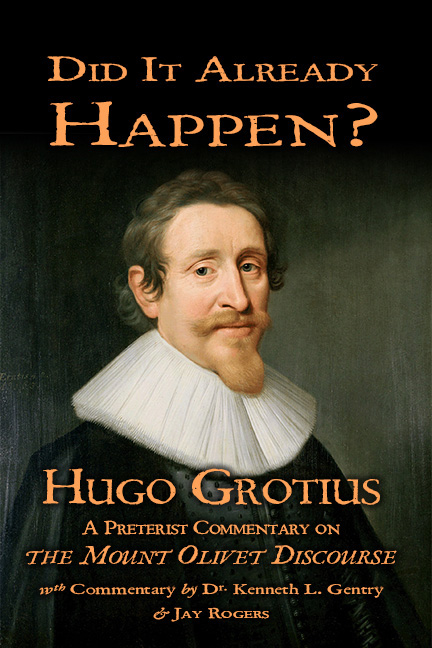
Imagine a teenage prodigy who becomes one of Europe’s greatest legal minds, only to be imprisoned in a castle for his religious views, before eventually escaping in a chest used for transporting books. That man was Hugo Grotius, and for the first time in history, his groundbreaking commentary on Matthew 24 is finally available in clear, readable English.
So, who was Hugo Grotius? Born in 1583, he was a Dutch humanist, diplomat, lawyer, and theologian who approached the Bible with the precision of a high-stakes jurist. While entire theological systems have been built — and dismantled — over the Mount Olivet Discourse, Grotius’ brilliant analysis remained largely out of reach, locked behind a wall of Neo-Latin, Greek, and Hebrew for nearly 400 years. This new publication is vital because Grotius is the hinge on which the entire conversation regarding preterism turns.
The book offers several revolutionary takeaways that challenge modern assumptions:
- The Three-Question Framework – Grotius argued that the disciples didn’t ask one confusing question in Matthew 24:3, but three distinct ones—about the Temple’s fall, the sign of Christ’s coming, and the end of the age.
- A Different View of “Coming” – In his most radical claim, he argued that the word Parousia in this context refers to the manifestation of Christ’s royal authority and the spread of His kingdom, rather than just the final judgment.
- The “Great Divide” at Verse 36 – Grotius identified a clear shift in the text where Jesus moves from predictable first-century events to the unpredictable timing of the final judgment.
- Literal “Generation” – He insisted that when Jesus said “this generation shall not pass,” He meant exactly what He said: the people living at that time would witness the destruction of Jerusalem in AD 70.
Why was — and is — this work groundbreaking? Grotius pioneered the historical-philological method, refusing to treat prophecy as a cryptic jigsaw puzzle. He treated the Bible as a legal case, weighing linguistic evidence and comparing it to contemporary witnesses like Josephus and Tacitus to show that Jesus’ predictions were fulfilled with devastating historical precision. He didn’t force the text into a single “past” or “future” box; instead, he saw three layers of prophecy, including a typological pattern where the judgment on Jerusalem serves as an “image and pledge” of the final global judgment.
If you are a Bible student tired of speculative “newspaper exegesis,” you need this book. Many modern arguments about the end times are simply repeating what Grotius addressed four centuries ago, and without his work, you are missing the foundation of modern preterist thought. Stop reading through the snippets of critics and hear the voice of the man himself. Grab your copy today and see how a brilliant legal mind can transform your understanding of the Olivet Discourse.
1 Comment
Is this book available now? I don’t see it in the Books for sale here on this site.
thanks,
Reuben